

Ho Chi Minh Thought on self-reliance and self-strengthening and its significance for building and developing a prosperous and powerful Vietnam in the new era
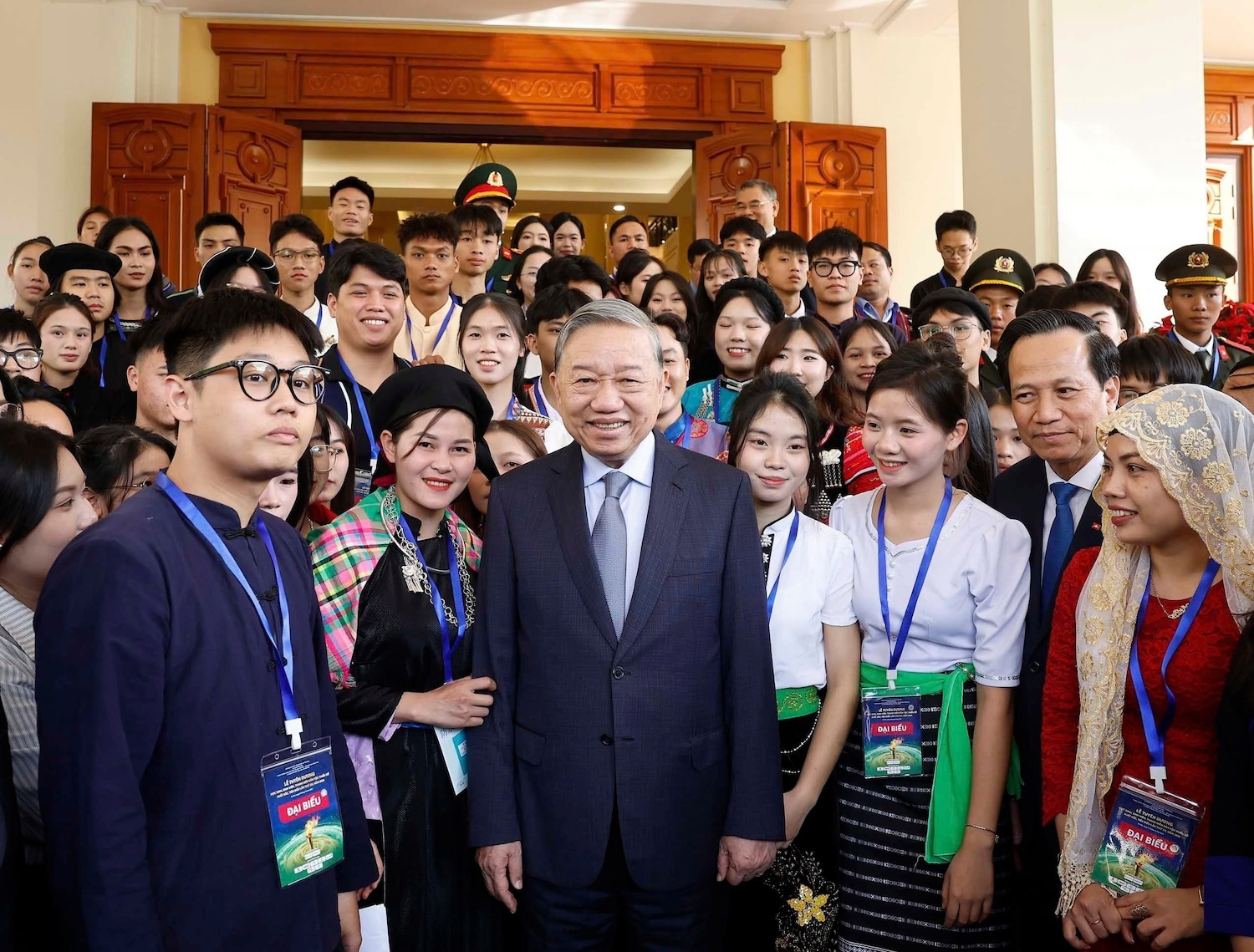
Party General Secretary To Lam meets outstanding ethnic minority delegates, pupils, students and young people representing ethnic minority youth from across the country Source: nhandan.vn
Communist Review - Ho Chi Minh Thought on self-reliance and self-strengthening constitutes a core and enduring value throughout the history of Vietnam’s revolution. It was shaped by the nation's cultural traditions and the progressive values of humanity and expressed through the wisdom, comprehensive vision and profound insight of President Ho Chi Minh.
In the new era, his thought on self-reliance and self-strengthening serves as a source of inspiration, a driving force and a guiding principle for Vietnam in realising its goal of maintaining independence and autonomy in formulating policies, guidelines and development strategies for the country.
Ho Chi Minh Thought on self-reliance and self-strengthening
Ho Chi Minh Thought on self-reliance and self-strengthening has long served as the foundation and guiding principle for securing and safeguarding national independence, freedom and sovereignty. It is clearly reflected in the achievements of the struggle for national liberation and resistance against foreign aggression, as well as in the system of policies and strategies aimed at ensuring autonomy in the fields of economy, politics, culture, defence and security. The core content of Ho Chi Minh Thought on self-reliance and self-strengthening is reflected in the following key propositions:
First, steadfast confidence in the strength of the people and the nation, and unwavering dedication to the goals of independence, freedom and socialism.
Throughout his great revolutionary life, President Ho Chi Minh consistently fought and devoted himself to the noblest cause - the interests of the nation. Through his compassion, intellect and practical experience, he early recognised that the strength of the country originates from its people and that the greatest responsibility was to fight for national liberation and bring prosperity, freedom and happiness to the people. He affirmed that “The country takes the people as its root” (1), and that “Nothing under the sky is more precious than people. Nothing in the world is stronger than the united force of the people” (2). He made every effort to awaken and maximise the power of self-reliance and self-strengthening among the people through movements such as the “all-people, comprehensive resistance war” and “all people as masters of the country”. In the Declaration of Independence, he affirmed Vietnam’s right to enjoy freedom and independence, declaring that the entire Vietnamese nation was determined to devote all its spirit and strength, lives and property to safeguarding that freedom and independence.
Second, independence must be won and defended through internal strength, in line with the country’s realities, without dependence on or reliance upon external assistance.
The spirit of self-reliance and self-strengthening was clearly reflected in President Ho Chi Minh’s search for a path to national salvation. Rather than following existing models, he creatively charted his own course. With an independent mindset, flexibility, adaptability and unwavering political courage, he persistently sought answers to the question of how to save the country and liberate the nation? To answer this question, he studied and examined various models from both East and West, eventually found the correct path suited to Vietnam’s realities and overcome the limitations of earlier patriots. He came to Marxism-Leninism and creatively applied it to the Vietnamese revolutionary cause, formulating the correct revolutionary line: national independence associated with socialism. Subsequently, he reminded the people that they must rely on their own strength in the struggle, without depending on external assistance, stressing that “Independence means that we manage all our own affairs without outside interference.” (3)
In the “Call for a General Uprising”, which paved the way for the August Revolution of 1945, President Ho Chi Minh clearly affirmed the principle of self-reliance and self-strengthening, calling upon the people to “liberate ourselves through our own efforts” (4). He then placed the task of building a new Vietnamese culture at the forefront, igniting the flames of patriotism and the spirit of independence and self-reliance(5). The same spirit was reflected in the Call for National Resistance issued on December 19, 1946: “Every Vietnamese must rise up to fight the French colonialists and save the Fatherland. Those who have guns should use guns. Those who have swords should use swords. Those without swords should use hoes, spades or sticks. Everyone must strive to resist the French colonialists and save the country.” (6)
Regarding the task of building an all-people comprehensive national defence system, he affirmed that: “In the past, warfare was conducted only on the military front, but today it is fought on every front - military, economic, political and ideological - and therefore it is called comprehensive warfare.” (7) He advocated that the people take up the struggle for national liberation themselves, without depending on others. To win freedom through one’s own efforts was a source of honour and pride, for “a nation that does not rely on its own strength but merely waits for another nation to come to its aid does not deserve independence” (8) and “Every citizen must understand that: only through self-reliance can there be independence, and only through self-strengthening can there be freedom.” (9) This thought on self-reliance and self-strengthening continued to develop during the resistance war against US imperialism, when he consistently called for an iron will and firm determination to achieve independence through the strength of the Vietnamese nation itself.
Third, national strength must be combined with the strength of the times, while internal strength remains the primary factor throughout the Vietnamese revolutionary process.
This viewpoint reflects a strategic, dialectical and creative vision of the Vietnamese revolution. Vietnam’s soft power is embodied in its patriotic tradition, spirit of solidarity, and determination for self-reliance and self-strengthening; these factors play the decisive role in every revolutionary victory. President Ho Chi Minh paid particular attention to maintaining a balance between internal and external resources in carrying out revolutionary tasks. He emphasised the importance of effectively mobilising internal strength in order to attract and effectively utilise external support, based on the principle that “If we want others to help us, we must first help ourselves.” (10)
At the same time, during the periods of resistance and national construction, although he consistently emphasised the importance of internal strength, he did not deny the significance of international support. As he noted, “Our friendly countries, first and foremost the Soviet Union and China, have wholeheartedly and selflessly assisted us, thereby creating more favourable conditions for us to rely on our own efforts.” (11) He also stressed that it was necessary to “take self-reliance as the foundation in responding to all developments of the situation; whether circumstances are favourable or difficult, we must remain proactive.” (12)
Fourth, self-reliance and self-strengthening constitute a principle for development and for enhancing international standing.
President Ho Chi Minh deeply understood that, throughout the revolutionary cause, assistance from international friends was important but could never replace the decisive role of the nation’s own internal strength. He emphasised: “When real strength is strong enough, diplomacy will succeed. Real strength is the gong, while diplomacy is its sound. Only when the gong is large enough can the sound be loud.” (13) In diplomacy and international cooperation, without real strength there can be no successful diplomacy, nor genuine equality, independence and self-determination, because “Only when we are strong will others ‘pay attention’ to us. If we are weak, we will merely become an instrument in the hands of others, even if those others happen to be our allies” (14).
On the other hand, President Ho Chi Minh consistently reminded the people, both before and after the seizure of power, of the need to be self-reliant and self-strengthening: “In the past, our people upheld the spirit of self-reliance and perseverance throughout the long resistance war; today we must uphold even more strongly the spirit of self-reliance and thrift in building our country.” (15)
In reality, Vietnam must always take the initiative in enhancing its internal capacity and its ability to make strategic decisions in international relations, while effectively leveraging international cooperation. Ho Chi Minh Thought on self-reliance and self-strengthening remains a guiding principle for national development. In this spirit, the policy of self-reliance, relying primarily on the nation’s own strength while effectively combining it with international cooperation, has become a fundamental orientation for the country’s development.
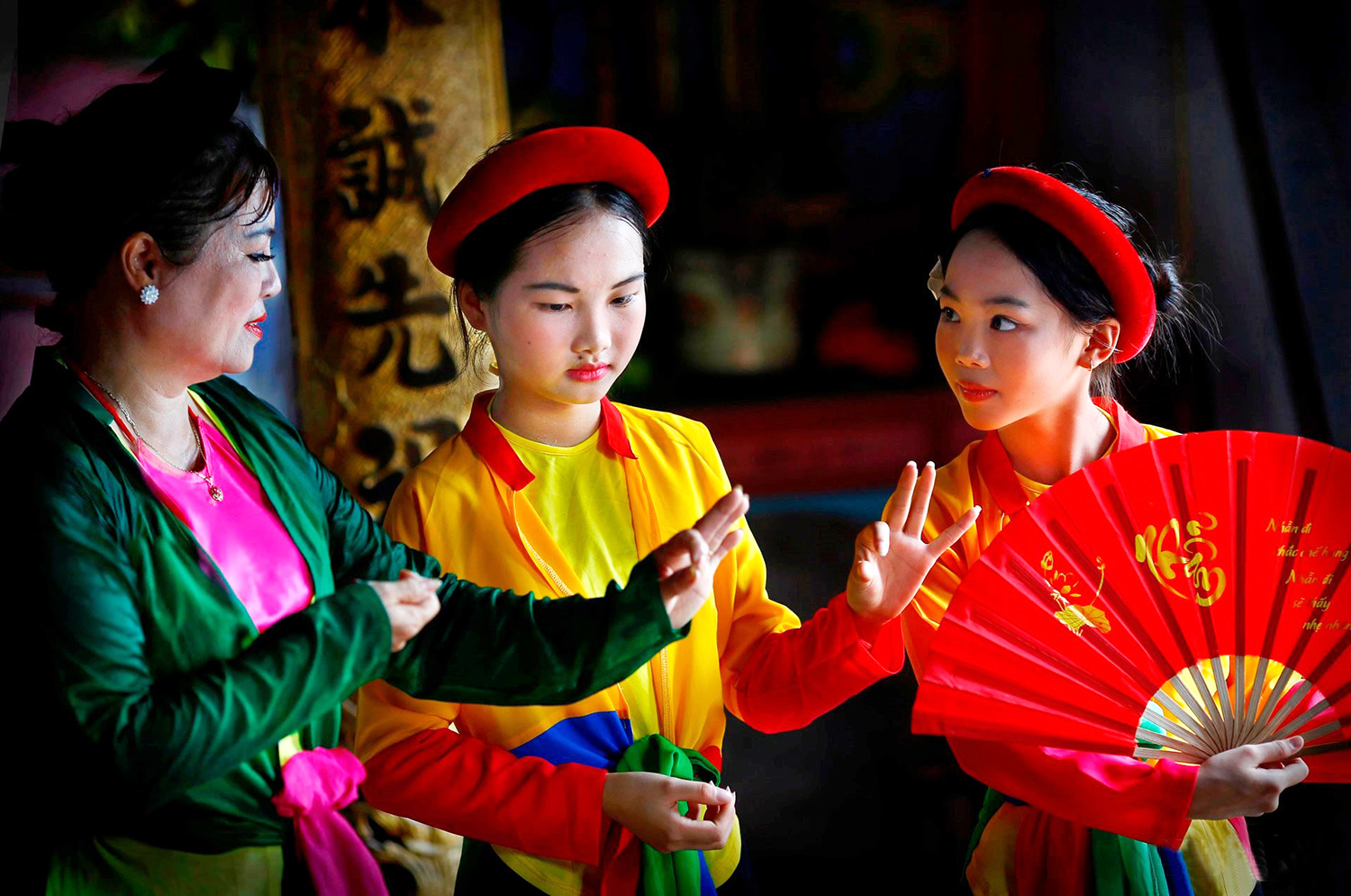
Passing cultural values on to future generations. Photo: Archive
Solutions for promoting the spirit of national self-reliance and self-strengthening in the new era
To further promote the spirit of self-reliance and self-strengthening of the Vietnamese nation in the new era, the following solutions should be considered:
First, raising awareness across society of the value of self-reliance and self-strengthening for the country’s sustainable development. This is a strategic task aimed at enabling Vietnam to soon become a powerful nation; while ensuring unity in objectives, methods and core values in the formulation of development guidelines, policies and strategies. It is necessary to inspire a spirit of initiative, creativity and responsibility among every individual, community, organisation and enterprise, thereby making important contributions to economic development, political stability, cultural advancement and the resolution of social issues.
The creative application of Ho Chi Minh Thought and the affirmation of its profound theoretical and practical value regarding the promotion of national self-reliance and self-strengthening should be carried out throughout the political system and incorporated into culture, education and communication in close connection with the realities of national development. In doing so, people will gain a fuller understanding of the dialectical relationship between internal strength and the capacity for self-determination in socio-economic development, national defence and security, while translating that understanding into conscious and proactive action.
At the same time, encouraging and publicly recognising exemplary models of self-reliance, creativity and dedication will help spread and translate the spirit of self-reliance and self-strengthening into an enduring value and a guiding principle for the actions of the entire population. Grounded in the strength of great national solidarity, closely aligning the Party’s will with the people’s aspirations, this spirit will help strongly inspire national pride, independence, self-confidence, self-reliance, self-strengthening and the aspiration for national development(26).
Particular attention should be paid to maintaining independence and self-determination in formulating guidelines, policies and development strategies in a context where globalisation and international integration are deeper, more complex and increasingly volatile; strategic competition among major powers, geopolitical divisions and conflicts are intensifying; and the Fourth Industrial Revolution is advancing rapidly. At this stage, safeguarding independence and self-reliance in formulating national policies, strategic orientations and development strategies has become an indispensable requirement for Vietnam.
Accordingly, efforts should be directed towards strengthening strategic decision-making autonomy in all fields, from the economy and politics to culture and beyond, while consistently implementing a foreign policy of “independence, self-reliance, peace, cooperation and development”, promoting multilateralisation and diversification of external relations, refraining from military alliances and avoiding alignment with any side.
Second, promoting internal strength, accelerating science and technology research and application, and fostering innovation; building a digital economy and digital society – This is the inevitable path towards realising the spirit of self-reliance and self-strengthening in the era of integration. The new context requires the fullest mobilisation of internal resources, including high-quality human resources, scientific and technological knowledge, and natural resources, in the service of sustainable national development.
Accordingly, Party and State policies must be implemented effectively, particularly the Politburo’s Resolution No. 57-NQ/TW, dated December 22, 2024, on “Breakthroughs in the development of science, technology, innovation and national digital transformation”, so as to ensure the “successful implementation of the digital transformation revolution, creating breakthroughs in the development of productive forces and the perfection of production relations, enabling our country and our nation to make extraordinary advances in the new era - an era of advancement, civilisation and modernity” (27).
The building of a digital economy and digital society should continue to be accelerated as a strategic step enabling Vietnam to integrate more deeply into global value chains, while both harnessing the achievements of the times and relying on national internal strength. Domestic capacity should be enhanced through improving the quality of human resources, efficiently utilising domestic resources, encouraging entrepreneurship and innovation in education, training, research and the application of scientific and technological achievements; upgrading digital infrastructure; ensuring cybersecurity; improving institutions; supporting technology enterprises; and strengthening national competitiveness in the context of the Fourth Industrial Revolution.
Third, nurturing a young generation with firm political mettle, a strong aspiration to contribute, the confidence to integrate into the world, and the capability to master advanced scientific and technological knowledge. The younger generation represents the future of the Fatherland and the successor generation that will determine the country’s sustainable development. Cultivating the spirit of self-reliance and self-strengthening among young people is both a political task and a long-term strategic mission, reflecting the creative application of Ho Chi Minh Thought in human resource development.
Young people should receive comprehensive education in morality, intellect, physical development and aesthetics; possess good qualities, capabilities, a spirit of self-reliance and responsibility; and be equipped with scientific and technological knowledge together with firm political mettle to confidently integrate into the world, in line with the aspiration that “Vietnamese youth will continue striving for self-determination, self-strengthening and national pride, making vigorous efforts for a prosperous people, a strong country, and a democratic, equitable and civilised society.” (28)
The education system must continue to reform its content and methods towards a competency-based approach, placing learners at the centre, building a democratic learning environment, and encouraging independent thinking, creativity and entrepreneurship. Education and training should be closely linked with enhancing the quality of scientific and technological research, foreign language proficiency and modern management skills. Policies for identifying, nurturing and utilising talented individuals should be implemented effectively so that young people can confidently integrate internationally, master cutting-age knowledge, demonstrate their capabilities, and contribute to the cause of national construction and defence.
Fourth, preserving and promoting national cultural identity while building Vietnamese people imbued with patriotism, self-reliance, self-strengthening, self-respect and self-confidence. Traditional national values should be harmoniously combined with the cultural quintessence of humanity, with the goal of developing individuals comprehensively in terms of intellect, morality, physical fitness and creativity.
Particular emphasis should be placed on fostering self-strengthening, self-reliance, self-respect and a sense of responsibility, enabling each individual not only to integrate internationally but also to preserve and promote national identity and to actively contribute to the country’s sustainable development. Education in ideals, national history and culture should be strengthened while being harmoniously combined with the finest values of world culture. The Vietnamese people of the new era should be developed comprehensively in intellect, morality, aesthetics and creativity, capable of embracing the best of global civilisation while steadfastly preserving the nation’s cultural identity.
Fifth, continuing to strengthen national defence and security, safeguarding independence and sovereignty, while expanding peaceful, friendly and cooperative foreign relations and seizing opportunities for development. A strong “people’s hearts-and-minds posture”, together with a robust all-people national defence posture and people’s security posture, should be built as the foundation for the cause of national defence. In the context of international integration, a foreign policy of peace and friendship not only contributes to creating a stable environment for development but also facilitates access to capital, science and technology, advanced management knowledge, and opportunities arising from globalisation and digital transformation. While strengthening domestic capacity, Vietnam should actively participate in international missions for peace and human progress, thereby enhancing the country’s position and prestige while maintaining independence, self-determination and self-reliance as the fundamental principle.
National defence and security capabilities should be further strengthened with regular, elite and modern forces, closely linked with the all-people national defence posture and the people’s security posture. At the same time, the country should steadfastly pursue an independent and self-reliant foreign policy, promote multilateralisation and diversification of external relations, proactively participate in international mechanisms, and effectively combine national strength with the strength of the times, thereby firmly safeguarding the Fatherland and ensuring rapid and sustainable development./.
------------------------------------------------------
*Associate Professor, PhD, Electric Power University
(1) Ho Chi Minh: Complete Works, National Political Publishing House, Hanoi, 2011, Vol. 5, p. 501.
(2) Ho Chi Minh: Complete Works, ibid., Vol. 10, p. 453.
(3) Ho Chi Minh: Complete Works, ibid., Vol. 5, p. 162.
(4) Ho Chi Minh: Complete Works, ibid., Vol. 3, p. 596.
(5) Ho Chi Minh: Complete Works, ibid., Vol. 3, p. 458.
(6), (7) Ho Chi Minh: Complete Works, ibid., Vol. 4, pp. 534, 342.
(8) Ho Chi Minh: Complete Works, ibid., Vol. 7, p. 445.
(9) Ho Chi Minh: Complete Works, ibid., Vol. 5, p. 553.
(10) Ho Chi Minh: Complete Works, ibid., Vol. 2, p. 320.
(11) Ho Chi Minh: Complete Works, ibid., Vol. 10, p. 103.
(12) Ho Chi Minh: Complete Works, ibid., Vol. 7, pp. 384–385.
(13) Ho Chi Minh: Complete Works, ibid., Vol. 4, p. 147.
(14) Complete Party Documents (1940-1945), National Political Publishing House, Hanoi, 2000, Vol. 7, p. 244.
(15) Ho Chi Minh: Complete Works, ibid., Vol. 14, pp. 27–28.
(16) See: Vu Dung, “Exports and imports approach historic milestone of 800 billion USD,” People's Army Newspaper Online, December 23, 2024.
(17), (18), (19) Documents of the 13th National Party Congress, National Political Publishing House, Hanoi, 2021, Vol. I, pp. 34, 115–116, 143.
(20) Documents of the 13th National Party Congress, ibid., Vol. I, p. 156.
(21) To Lam: “Some fundamental contents on new era, the era of nation’s rise, and strategic orientations for bringing the country into the new era,” Communist Review, No. 1050 (November 2024), p. 3.
(22) See: Le Huu Nghia: “The country’s fortunes, potential, position, prestige and comprehensive national strength after nearly 35 years of renewal,” Communist Review Online, October 20, 2020.
https://www.tapchicongsan.org.vn/web/guest/gop-y-du-thao-cac-van-kien-trinh-dai-hoi-xiii-cua-dang/-/2018/820121/co-do%2C-tiem-luc%2C-vi-the%2C-uy-tin%2C-suc-manh-tong-hop-cua-quoc-gia---dan-toc-sau-gan-35-nam-doi-moi.aspx
(23) Documents of the 13th National Party Congress, ibid., Vol. II, p. 322.
(24) See: To Lam: “Continuing to strongly renew the Party’s leadership and governance methods - an urgent requirement of the new revolutionary stage,” Communist Review, No. 1046 (September 2024), pp. 18–19.
(25) See: Nguyen Quoc Thai, “Theory of renovation policy and market economy development - Core values and issues requiring further supplementation and improvement,” Communist Review Online, July 31, 2023.
(26) See: “General Secretary To Lam Delivers a Thematic Presentation on ‘A New Development Era – The Era of the Vietnamese Nation’s Rise’,” Communist Review Online, November 25, 2024.
(27) See: To Lam: “Digital transformation - an important driver for developing productive forces and improving relations of production to bring the country into a new era,” Communist Review, No. 1045 (September 2024), p. 7.
(28) See: “Party General Secretary To Lam: Youth key force in shaping and developing the country’s future,” Communist Review Online, December 18, 2024.
https://www.tapchicongsan.org.vn/web/guest/nghien-cu/-/2018/1024102/view_content


