

Vietnam’s defence cooperation and international integration in the era of the nation’s rise
Vietnam is preparing to enter a new era — an era of the nation’s rise — and to soon realise its aspiration and goal of becoming a developed, socialist-oriented country by the mid-21st century. This marks a historic milestone for Vietnam on its path towards achieving the objectives of a prosperous people, a powerful nation, democracy, justice, and civilisation, standing shoulder to shoulder with the powers across the five continents. The new context presents the country with new requirements and tasks regarding cooperation and international integration in the field of defence.
Promoting the essential role of defence cooperation and international integration contributes to establishing and maintaining a peaceful and favourable environment for national construction and development.
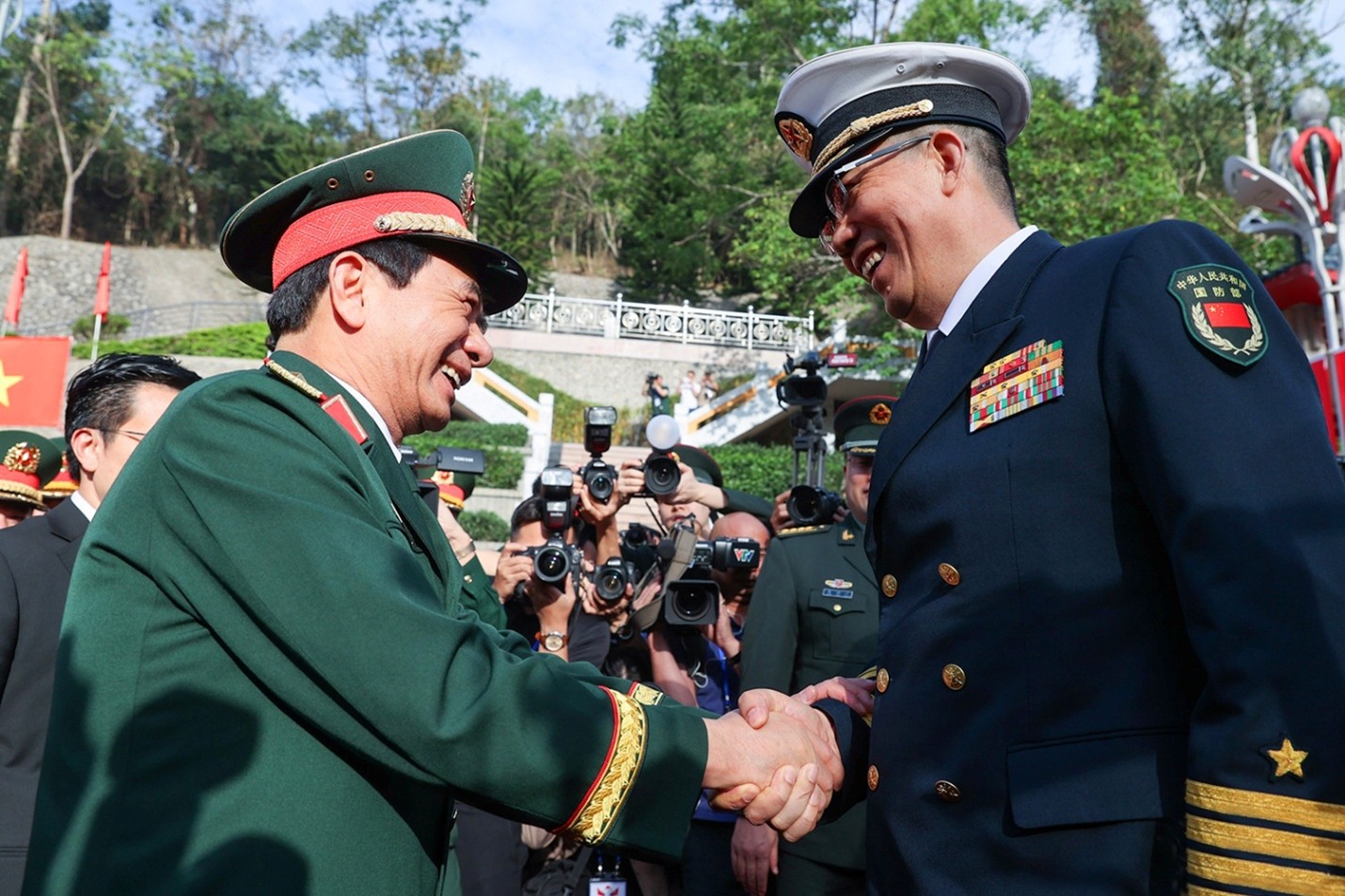
General Phan Van Giang, Politburo member and Minister of National Defence, and Senior Lieutenant General Dong Jun, Minister of National Defence of China, attend the ninth Vietnam–China Border Defence Friendship Exchange Programme Source: vietnamnet.vn
In recent years, the Politburo, the Party Central Committee, the Secretariat of the Party Central Committee, the Central Military Commission, and the Ministry of National Defence have focused on leading, directing, and issuing numerous documents to define major orientations and policies regarding cooperation and international integration in the field of defence. (1)
Bilateral defence cooperation has been implemented synchronously, increasingly going into depth and substance, thereby strengthening political trust, maintaining friendly relations with other nations, and effectively resolving issues related to borders and territories; safeguarding and ensuring security and safety along the national borderlines. To date, Vietnam has expanded and established defence cooperation relations with more than 100 countries, including all five permanent members of the United Nations Security Council and all major powers around the world. Many important documents on defence cooperation have been signed and effectively implemented, such as joint vision statements on defence cooperation, memoranda of understanding on bilateral defence cooperation, protocols, and three-year and five-year cooperation programmes and plans. These documents have truly deepened defence relations, consolidated political trust, and enhanced the effectiveness of cooperation with all partners across various fields.
Border defence friendship exchange activities with China, Laos, and Cambodia (2); the Vietnam–Laos–Cambodia Border Defence Friendship Exchange Programme; annual meetings between the Ministers of National Defence of Vietnam, Laos and Cambodia, as well as joint military exercises of the Vietnamese, Lao and Cambodian armies on rescue, disaster relief, and military medicine have all contributed to strengthening defence relations toward closeness, solidarity, friendship, and mutual trust with neighbouring countries, thereby firmly ensuring a direct security belt for the nation. At the same time, defence cooperation and international integration play an important role in building and consolidating strategic trust with other countries and international organisations, while also garnering support from the international community for the nation’s core interests. The Vietnamese Ministry of National Defence has proactively participated in regional and international multilateral forums (the ASEAN Defence Ministers’ Meeting (ADMM), the ASEAN Defence Ministers’ Meeting Plus (ADMM+), Shangri-La Dialogue, the Moscow International Security Conference, and the Xiangshan Forum in Beijing…); successfully hosted many practical cooperative activities, actively deployed forces to participate in ASEAN cooperation mechanisms; actively and flexibly mobilised cooperation and promoted the implementation of commitments with partners in overcoming war consequences, while coordinating the search for missing-in-action soldiers.
Since 2014, the Vietnam People’s Army has sent more than 1,100 personnel to participate in United Nations peacekeeping missions, both individually, in units, and at the UN headquarters. In 2023, the Ministry of National Defence dispatched forces to assist in rescue and disaster relief efforts following the earthquake in Türkiye; in 2025, rescue forces participated in operations responding to the earthquake in Myanmar, demonstrating a proactive and highly responsible attitude which received positive recognition from the United Nations, the people of Myanmar, and the international community.
Defence cooperation and international integration are key factors influencing the task of strengthening national defence potential, building an elite army moving towards modernisation, meeting the requirements of safeguarding the Fatherland in the new situation. Through training cooperation programmes with foreign militaries and participation in United Nations peacekeeping operations, officers and soldiers of the Vietnam People’s Army have had opportunities to engage, learn, and gain experience in international environments, helping them accumulate valuable expertise while enhancing the image, position, and prestige of the country and its army in the eyes of international friends.
At the same time, through cooperation in procurement, research, technology transfer, participation in international defence exhibitions, Vietnam has been able to access advanced technologies, promote collaboration in technology transfer, and master modern technology; strengthen the country’s capacity for self-production of high-tech weapons and equipment, enhancing overall defence potential. Particularly in 2022 and 2024, the Ministry of National Defence successfully organised two editions of the Vietnam International Defence Expo, attracting the participation of numerous leaders from defence ministries and armed forces of various countries, along with hundreds of major defence corporations and enterprises in and outside the country to visit and display at the events, helping foster public confidence in the nation’s defence capabilities and potential.
Enhancing defence cooperation and international integration to effectively serve the cause of national construction and defence in the new era
The world today faces unprecedented obstacles and challenges, with rapid, complex, and unpredictable developments. However, “peace, cooperation, and connectivity for development remain the prevailing trend. Globalisation and international integration are deepening, yet they are being challenged by competition among major powers and the resurgence of extreme nationalism.” (3) The world situation is increasingly characterised by multipolarity, multi-centricity, and polarisation in international relations, accompanied by intensified competition and coalition-building efforts. The growing trend of threats or use of force to resolve disputes among nations negatively affects the principles of respect for peace, international law, and global order. Non-traditional security issues, such as transnational crime, energy and food security, cybersecurity, and climate change, are becoming more complicated, profoundly impacting individual nations, regions, and the world as a whole, requiring collective international cooperation and response.
Domestically, after nearly 40 years of the Doi moi (Renewal) process, “our country has never enjoyed such a fortune, potential, status and international prestige as it does today.”(4) From a war-torn, besieged and isolated nation once facing numerous hardships, Vietnam has now established diplomatic relations with 194 out of 200 countries, built strategic and comprehensive partnerships with over 30 countries (as of March 12, 2025, Vietnam had established comprehensive strategic partnerships with 12 nations(5)), and actively participated in more than 70 regional and international organisations.
Nevertheless, Vietnam continues to face major barriers and challenges stemming from the evolving global and regional situation, including developments in the East Sea, the maintainance of cooperation and the utilisation of Mekong River water resources, and response to non-traditional security threats... Hostile forces are also intensifying their sabotage activities with new conspiracies and tactics, becoming increasingly overt and direct. In the current context, the task of building a “elite, compact, and strong” military that is increasingly revolutionary, regular, elite, progressively modernised, and capable of defence cooperation and international integration has become increasingly urgent. Accordingly, to improve the effectiveness and promote the role of defence cooperation and international integration in service of national construction and protection in the new era, several key tasks and solutions should be emphasised:
First, continue strengthening the Party’s leadership and enhancing the effectiveness and efficiency of the State’s management over military and defence affairs in general, and over defence cooperation and international integration in particular. This is both an important and decisive solution, as well as a requirement in leading and managing the task of combining diplomacy with the assurance of national defence and security. Regularly grasp and effectively implement the Party’s resolutions, directives, and conclusions, flexibly and creatively apply them to the task of strengthening national defence potential, security and foreign affairs, closely following the orientations stated by the General Secretary of the Communist Party of Vietnam and Secretary of the Central Military Commission, To Lam, at the 12th meeting of the Central Military Commission. Consistently implement the foreign policy of independence, self-reliance, peace, friendship, cooperation and development, diversification and multilateralization of cooperative relations under the motto “more friends, fewer enemies,” ensuring to the utmost the national interests on the basis of the fundamental principles of the United Nations Charter and international law, equality, cooperation, and mutual benefit.
Defining independence, self-reliance, self-strength, and self-resilience in close association with solidarity and international cooperation is a top priority in the national defence strategy. Link defence cooperation and international integration with the overall strategy of the Party’s external affairs, state diplomacy, and people-to-people diplomacy, proactively prevent and address early and from afar any risks of infringement upon the independence, sovereignty, unity, and territorial integrity of the Fatherland, build trust and effectively utilise peaceful measures based on international law. At the same time, remain steadfast in implementing the “four no’s”(6) defence policy in international relations.
Second, building upon the nation’s fine traditions and Vietnam’s diplomacy, continuing to uphold the pioneering role in safeguarding the Fatherland early and from afar, defence cooperation and international integration should aim to achieve the following fundamental objectives:
1. Serve as a channel for both cooperation and struggle, contributing to preventing the risk of conflict and war, minimising non-traditional security challenges, safeguarding independence, sovereignty, unity, and territorial integrity, the country’s and national interests, the people, the Party, and the socialist regime;
2- Further expand defence and security relations with other nations and international organisations and institutions, ensuring that cooperation is deeper, substantive and effective; strengthen the linkage of strategic interests, enhance Vietnam’s position and the military’s reputation, and effectively leverage external resources to consolidate the posture and strength of the all-people national defence;
3- Create favourable conditions for economic and comprehensive international integration across various fields; maintain a stable and favourable international environment for national construction and defence, while actively contributing to regional and global peace, stability, and prosperity.
Third, implement defence cooperation and international integration in a synchronous, comprehensive and effective manner, build trust, maintain strategic balance, avoid confrontation, and prevent involvement in great-power rivalries. Continue consolidating, strengthening, and proactively managing defence relations with neighbouring countries, regional states, major powers, strategic partners, comprehensive partners, and traditional friends, ensuring to the utmost the national interests on the basis of respect for the UN Charter and international law, equality, cooperation, and mutual benefit. During the implementation, it is essential to remain steadfast on matters of principle - such as territorial sovereignty, independence, self-reliance, and national interests - while maintaining flexibility in the conduct of relations and proactively identifying “partners” and “adversaries” in order to both cooperate and struggle, expand cooperation without causing conflict or confrontation, and avoid isolation or being forced to take sides.
Focus on achieving substantive effectiveness in defence cooperation, regularly review and promote the implementation of cooperation agreements with countries to which Vietnam is a signatory, with an emphasis on key areas; maintain and strengthen consultation and dialogue mechanisms; enhance cooperation in training, joint operations among military services and branches, military technology, defence industry, maritime security, strategic research, remediation of war consequences, humanitarian assistance, disaster relief, military medicine, and participation in United Nations peacekeeping operations. Strengthen border diplomacy by enhancing cooperation and exchange mechanisms among border protection forces, building borders of peace, stability, cooperation, friendship, and development. Focus on promoting technical–military cooperation, combining military trade with technology transfer, joint production, and product distribution, thereby enhancing self-production capacity and the application of advanced management and manufacturing processes. This, in turn, will accelerate the modernisation of weapons and equipment and improve the combat capabilities of the Army, meeting the requirements of national defence in the new era.
Continue advancing and elevating multilateral defence cooperation and international integration in accordance with Directive No. 25-CT/TW (dated August 8, 2018) of the Secretariat of the Party Central Committee on “Promoting and elevating multilateral diplomacy to 2030,” shifting from receiving to contributing, from learning to leading, from comprehensive to deep and substantive integration and proactive making proposals and initiatives at regional and international multilateral defence forums, considering them as an opportunity to enhance mutual understanding, trust, and cooperation in dealing with emerging matters and preventing conflicts, promoting peace and stability in the region and the world.
Continue expanding participation in UN peacekeeping operations, increasing both the scale and scope of deployments, harmonising national interests with regional and global priorities, thereby securing international support while demonstrating the Vietnam People’s Army’s role and responsibility in addressing regional and global security challenges; elevating the country’s status and prestige, spreading Vietnamese cultural values and defence policies, and promoting the image and noble virtues of the “Uncle Ho’s Soldiers” to the international community.
Fourth, continue improving the legal framework concerning defence cooperation and international integration to ensure the highest level of protection for the socialist Fatherland, serving as a foundation for the effective and consistent implementation of defence cooperation and international integration both in the immediate and long-term future. Strengthen foreign relations, promote the role and specific characteristics of each diplomatic channel in a manner suited to their features and strengths, remain steadfast in principle while flexible in tactics, thereby creating comprehensive and synergistic strength, and further enhance research, situation forecasting, and academic exchanges and defence consultations.
Fifth, actively renovate organisational structures and organise and develop a contingent of personnel engaged in defence cooperation and international integration commensurate with mission requirements. Focus on training and fostering officials engaged in defence cooperation and international integration who are both morally sound and professionally competent, politically steadfast, ethically upright, dedicated, and possessing strong expertise, foreign language proficiency, and adaptability, and who are well-equipped with knowledge, skills, and an understanding of foreign affairs, international cooperation, and the traditions, customs, and legal systems of host countries.
------------------------------------------------
* Senior Lieutenant General, Associate Professor, Doctor, Member of the Party Central Committee, Member of the Standing Board of the Central Military Commission, Deputy Minister of National Defence
(1) The Politburo’s Resolution No. 34-NQ/TW, dated January 9, 2023, on “Several major orientations and policies for implementing the foreign policy set forth by the 13th National Party Congress”; the Politburo’s Conclusion No. 53-KL/TW, dated April 28, 2023, on “International integration and defence diplomacy towards 2030 and beyond”; the Politburo’s Resolution No. 59-NQ/TW, dated January 24, 2025, on “International integration in the new situation”; the Central Military Commission’s Resolution No. 2662-NQ/QUTW, dated February 26, 2024, on “International integration and defence diplomacy towards 2030 and beyond”….
(2) In 2022, Vietnam hosted the first Vietnam–Cambodia Border Defence Friendship Exchange (May 15, 2022); in 2024, Vietnam hosted the 8th Vietnam–China Border Defence Friendship Exchange (April 11–12, 2024) and the 2nd Vietnam–Laos Border Defence Friendship Exchange (October 22–23, 2024),...
(3) Documents of the 13th National Party Congress, National Political Publishing House, Hanoi, 2021, Vol. I, p. 105.
(4) Documents of the 13th National Party Congress, ibid., Vol. I, p. 25.
(5) See: Vietnam News Agency, “12 countries establishing Comprehensive Strategic Partnership with Vietnam”, March 12, 2025, https://www.vietnamplus.vn/12-nuoc-co-quan-he-doi-tac-chien-luoc-toan-dien-voi-viet-nam-post1020114.vnp
(6) Vietnam consistently upholds the principles of not joining any military alliances; not aligning with one country against another; not allowing any foreign country to establish military bases or use Vietnamese territory against other countries; and not using or threatening to use force in international relations.


