Social policy for sustainable development in new era
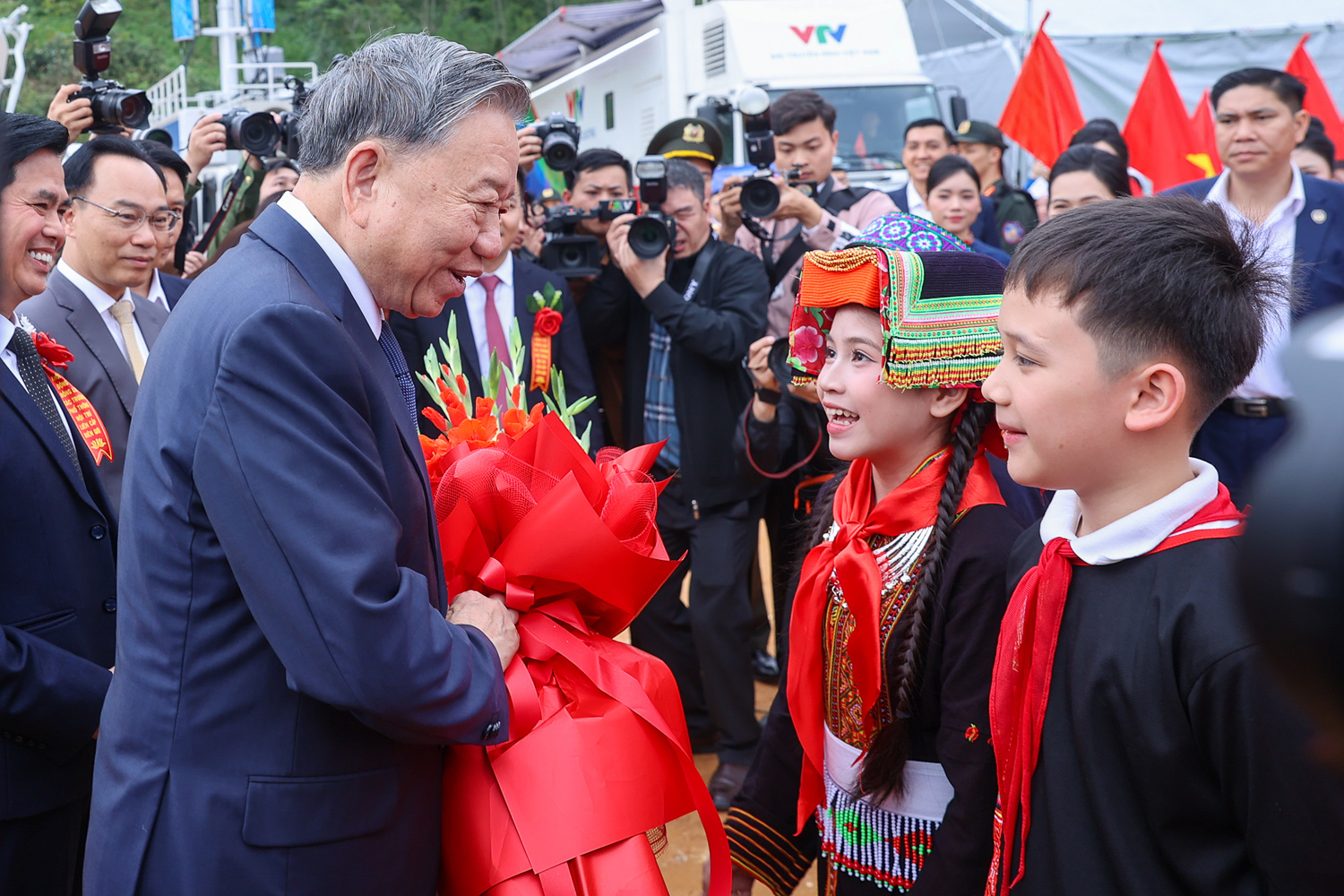
Pupils at the Dong Dang Boarding Primary and Secondary School, Dong Dang commune, Lang Son province, present flowers to welcome General Secretary To Lam Photo: VGP
Communist Review - As the country enters a new era, in line with Resolution No. 42-NQ/TW dated November 24, 2023, of the 8th Plenum of the 13th Party Central Committee, on continuing to renew and improve the quality of social policies to meet the requirements of national construction and defence in the new period, it is increasingly imperative to fundamentally reform thinking and the institutional framework of social governance towards a more inclusive, modern and sustainable approach. This affirms that people are at the centre, the central actor and the driving force of Vietnam’s development strategy in the coming period.
Human rights relating to social security and social welfare, including the right to education, the right to protection and healthcare, the right to work, and the right to lawful housing, among others, are fundamental rights enshrined in the Constitution.
In the context of profound global and regional transformations driven by digital transformation, the green transition, population ageing, climate change and non-traditional security risks, the need to further improve social policy in Vietnam has become increasingly urgent. This is required not only to ensure a minimum level of social protection, but also to enhance universal welfare and advance the sustainable governance of social development.
With a full and thorough understanding of the Party’s viewpoint that human beings are the subject, the goal and the driving force of development, the improvement of social policy in the new era carries long-term strategic significance, while also constituting an urgent requirement of current national development practice. Resolution No. 42-NQ/TW has marked an important shift in development thinking and approach, from “ensuring and stabilising” to “stabilising and developing”, placing people at the centre of the national sustainable development strategy(1).
Orientation and viewpoints on social policy in sustainable development
The Communist Party of Vietnam’s viewpoints on social policy have been formed and continuously refined through successive National Party Congresses and official documents. According to the documents of the 13th National Party Congress, social security is not only a humanitarian policy but also a fundamental right of citizens. It serves as a key pillar for ensuring social progress, equity, and long-term socio-political stability.
In implementing social policies, the State plays the leading role while also promoting the responsibility and participation of businesses, communities and citizens(2).
Resolution No. 15-NQ/TW, issued on June 10, 2012, by the 5th Plenum of the 11th Party Central Committee on several issues on social policy for the 2012–2020 period, laid the foundation for a comprehensive approach, calling for the harmonious integration of social security with other social policies to promote social progress(3).
Subsequently, the 13th National Party Congress set the goal of transforming Vietnam into a developed, high-income country by 2045, thereby underscoring the need to further reform and improve the quality of social policies and social development governance in a comprehensive, effective and sustainable manner(4).
Building on this foundation, Resolution No. 42-NQ/TW clearly affirms the orientation of developing a progressive and equitable social policy system, with comprehensive reforms in both policy content and implementation mechanisms to meet the requirements of development in the new period(5).
A consistent message running through the Party’s guidelines and the State’s policies is that social policy must serve the entire population while ensuring comprehensiveness, equity, modernity, inclusiveness and sustainability, leaving no one behind.
This requires sustained efforts to develop a multi-tier social insurance and health insurance system, expand and improve the effectiveness of social assistance for vulnerable groups, and continuously enhance the quality of essential public services, including healthcare, education, housing and the living environment.
In line with this orientation, the Government has issued an action programme to implement Resolution No. 42-NQ/TW. The programme sets out clear objectives and key targets for the development of social and social security policies, providing a foundation for coherent implementation across the entire political system(6).
This approach has shaped a consistent policy orientation in which the State plays the central role in designing and regulating social policy while mobilising the participation of the market, social organisations and citizens. It seeks to ensure that all people benefit from the fruits of development, thereby creating a strong social foundation for the country’s goal of rapid and sustainable development.
Social security system contributes to strengthening social stability and improving people’s living standards
In recent years, social insurance, unemployment insurance and health insurance policies have continued to be implemented in a coordinated manner, achieving significant results and reaffirming their central role within the social security system and the country's progress towards universal coverage.
Social insurance coverage has expanded markedly. By the end of 2025, approximately 21.34 million people were participating in social insurance schemes, accounting for 45.04 percent of the working-age labour force. Of these, 3.17 million were enrolled in voluntary social insurance, exceeding the target set(10).
Notably, the 2024 Law on Social Insurance, which took effect on July 1, 2025, marks a major breakthrough in expanding access to pension security and is expected to raise pension coverage to around 50 percent. Unemployment insurance has continued to serve as an important social safety net for the labour market, with around 35 percent of the labour force participating in the scheme(11).
Universal health insurance has also achieved remarkable progress, with approximately 97.42 million participants, representing 95.16 percent of the population(12), surpassing the target set under Resolution No. 68/NQ-CP.
The social insurance system is increasingly evolving from a model focused primarily on protection to one that supports development. It not only safeguards people against risks but also provides a sustainable social security foundation for the country's stability and development.
To date, social assistance policies have expanded to cover approximately 20 percent of the population, with around 4.5 million people receiving regular social assistance benefits and social pensions, an increase of 43.77 percent compared with 2021. All localities have adopted benefit payments through cashless methods or the postal service. Emergency social assistance has also been delivered in a timely manner. Since 2021, the State has provided 237,778.5 tonnes of rice to nearly 3.9 million households facing food shortages. Thousands of billions of VND have been mobilised to support recovery efforts following natural disasters and other calamities. Policies for older persons and persons with disabilities have continued to expand, with 95 percent of older persons covered by health insurance. Around 2 million older persons and 1.71 million people with severe or particularly severe disabilities are currently receiving monthly social assistance benefits(13).
Sustainable poverty reduction efforts have continued to be implemented through a multidimensional, coordinated and innovative approach that combines infrastructure development with livelihood support, job creation and vocational training. By the end of 2025, the national multidimensional poverty rate had fallen to approximately 0.9–1 percent, while the average annual reduction during the 2021–2025 period exceeded 1 percent, meeting and surpassing targets set by the National Assembly and the Government. Under the National Target Programme on Sustainable Poverty Reduction, nearly 5,000 essential infrastructure projects were built or upgraded, and more than 10,500 poverty reduction models and projects were implemented, attracting the participation of over 205,000 households. These efforts have helped improve livelihoods, promote economic restructuring, and bring tangible improvements in living conditions and access to basic social services in disadvantaged areas(14).
Notable achievements in social policy implementation
Over the 40 years of Doi Moi (Renewal) since 1986, Vietnam’s social policies have achieved comprehensive and strategically significant results. They have become an important pillar for maintaining socio-political stability, improving people's living standards, and strengthening the foundation for the country's sustainable development.
In particular, since the issuance and implementation of Resolution No. 42-NQ/TW, the social policy system has been progressively refined and more closely integrated with sustainable social development governance, ensuring better protection of the legitimate rights and interests of the people.
Preferential policies for people with meritorious service reaffirm their key role within the social policy system
Policies and measures such as providing 100 percent health insurance coverage, housing support, free medical examination and treatment, vocational training, concessional loans, employment assistance, and care for the children of people with meritorious service all reflect the profound responsibility and enduring moral commitment of the Party and the State towards those who have contributed and sacrificed for the nation's independence and freedom.
On July 1, 2024, the Government issued Decree No. 77/2024/ND-CP amending and supplementing a number of provisions of Decree No. 75/2021/ND-CP on benefit levels, allowances and preferential policies for people with meritorious service to the revolution, as previously amended by Decree No. 55/2023/ND-CP.
The decree increased the standard preferential allowance level from 2.055 million VND to 2.789 million VND, a rise of 35.7 percent, the largest increase in several decades. Together with the full, timely, transparent and accountable implementation of related policies, the adjustment has significantly improved the living standards of people with meritorious service. As a result, no households of people with meritorious service remain below the poverty line.
From January 1, 2023, to July 16, 2025, the State provided allowances to more than 1.03 million people with meritorious service, with total expenditure exceeding 26.4 trillion VND. During the same period, 34,754 households of people with meritorious service and relatives of martyrs received housing support, with the programme completed ahead of schedule(7).
Preferential policies for people with meritorious service continue to reaffirm their central role within the social policy system. They have helped strengthen public confidence, reinforce the great national unity bloc, and provide a solid social foundation for the country's development in the new era.
Coordinated human resource and labour market development achieves positive results
During the 2024–2025 period, efforts to develop human resources, particularly high-quality human resources, were carried out in tandem with fundamental and comprehensive reforms in education, training and vocational education. These reforms have been pursued in an open, flexible, modern and internationally integrated manner to meet the requirements of digital transformation, the green transition and innovation.
The scale and quality of training have improved significantly. Vocational education enrolment reached approximately 2.05 million learners in 2024, while the post-training employment rate exceeded 80 percent. Many training programmes have focused on high-tech industries, the digital economy, the green economy and strategic industries.
The coordinated implementation of labour market development solutions during the 2022–2025 period, particularly in the aftermath of the COVID-19 pandemic, has helped maintain a labour market that is flexible, modern and sustainable. It has also strengthened resilience to economic shocks and promoted a positive shift in the labour structure.
The scale and quality of employment have continued to improve. In 2025, the number of employed workers reached 52.4 million, an increase of 578,300 compared with the previous year. The unemployment rate among the working-age population remained low at 2.22 percent, while the underemployment rate declined to 1.65 percent. Average monthly income reached 8.4 million VND, up 8.9 percent year-on-year. The labour structure continued to shift towards the industrial and services sectors, while the proportion of informal workers fell to 63.4 percent(8).
Labour market support instruments have continued to prove effective, particularly policy credit programmes for job creation. Loan disbursements for employment support reached 22.625 trillion VND in 2024 and 17.443 trillion VND in the first six months of 2025, helping create and sustain jobs for more than 600,000 workers. The employment service system has also been modernised. In 2025 alone, it provided career guidance and employment counselling to 3.8 million people and job placement services to more than 1 million workers. In addition, more than 144,000 Vietnamese workers were sent abroad under contractual employment arrangements in 2025(9), contributing to higher skills, increased incomes and improved human resource quality.
Solutions to improve and enhance social policy effectiveness in new era
Vietnam is steadily advancing into a new era of rapid, sustainable, prosperous and happy development. In this new era, the highest development goal consistently pursued by the Communist Party of Vietnam is the well-being of the people, the building of a stable, progressive and equitable society in which all citizens benefit from the achievements of renewal and development.
The report on documents submitted to the 14th National Party Congress continues to reaffirm a consistent viewpoint: “stability through development, and development driven by stability in order to promote rapid and sustainable growth; improve the living standards and happiness of the people; and firmly safeguard the Socialist Republic of Vietnam”(17).
In line with the spirit of Resolution No. 42-NQ/TW, the improvement of social policy in the new era requires a fundamental shift in thinking and approach, towards inclusiveness, sustainability and a people-centred orientation. Social policy must be designed in a way that both ensures social protection and promotes development, both provides support and creates opportunities, and both safeguards and unlocks the potential, responsibility and contributions of each citizen, closely linked with sustainable governance of social development.
The improvement of social policy is not only an immediate task but also a long-term strategic mission, aligned with the country’s development goals towards 2030 and its vision for 2045. It requires the coordinated involvement of the entire political system, the active participation of society, and the broad consensus of the people. In the coming period, efforts should focus on the following key solutions:
First, improving institutions and reforming the State management of social policy
It is necessary to continue reviewing and refining the legal and policy framework on social issues in a more synchronised, consistent and flexible manner, laying the foundation for a multi-tier, inclusive and sustainable social policy system. Priority should be given to improving legislation on social insurance, health insurance, social assistance, older persons, poverty reduction and social housing. In particular, the development of a multi-tier social insurance system should be promoted, coverage expanded, and the long-term financial sustainability of social security funds ensured.
State management should be renewed towards a more enabling and modern approach. Digital transformation should be accelerated, data transparency enhanced, and policy forecasting capacity strengthened in close connection with population planning and the labour market. Greater attention should also be paid to improving the quality of the social policy workforce, while linking administrative reform with enhanced quality of public services for citizens.
Second, expanding social security coverage towards universality, inclusiveness and sustainability
Efforts should be intensified to advance the goal of universal social insurance, with a focus in the immediate term on expanding voluntary social insurance and ensuring access to social security for informal workers and vulnerable groups.
The effectiveness of social assistance should be improved in the direction of guaranteeing a minimum standard of living, with a clear roadmap and priority given to the poor, older persons without pensions, persons with disabilities and other vulnerable groups.
The principle of “leaving no one behind” should be consistently implemented, while narrowing disparities in access to social services between regions, particularly remote, mountainous and ethnic minority areas. Investment should be balanced between economic growth and social policy implementation, towards the objective of becoming a upper-middle-income country by 2030 and achieving universal social security coverage.
Third, developing human resources and creating sustainable employment
Investment in people should be regarded as an investment in sustainable development. Priority should be given to education and training, vocational education and healthcare, while ensuring stronger alignment between training and labour market demand. Greater emphasis should be placed on digital skills, green skills and reskilling for occupational transition, particularly for rural workers, women and young people.
A modern and flexible labour market should be developed, with stronger incentives for the creation of sustainable jobs linked to green growth and the circular economy. Digital platforms, artificial intelligence (AI) and big data should be effectively leveraged to generate momentum in today’s digital workplace, thereby improving work efficiency while strengthening long-term competitiveness in the digital era.
Fourth, promoting digital transformation and modernising social service delivery
It is necessary to develop and effectively utilise the national database on population and social security, while strengthening data integration and sharing across sectors to improve governance efficiency and reduce policy duplication. Public online services in the fields of insurance, social assistance, healthcare and education should be expanded, gradually building a smart social service system that is people-centred, more transparent and more accessible.
Social security objectives should be integrated with green growth, climate change adaptation and environmental protection. Sustainable livelihoods should be developed for the poor and vulnerable groups, while enhancing the resilience and adaptive capacity of the social security system to economic and social shocks as well as natural disasters.
The close integration between social policy and sustainable development strategy is a core orientation, placing people at the centre and considering social progress and equity as drivers of development. It ensures that economic growth goes hand in hand with cultural development and social security, contributing to the building of an inclusive and humane society in the new era.
Inclusive and sustainable social development represents the path towards realising the aspiration for a prosperous, equitable, democratic and civilised Vietnam, where people live safely and happily, and no one is left behind./.


