

Party inspection and supervision amid payroll streamlining and three-tier government model implementation
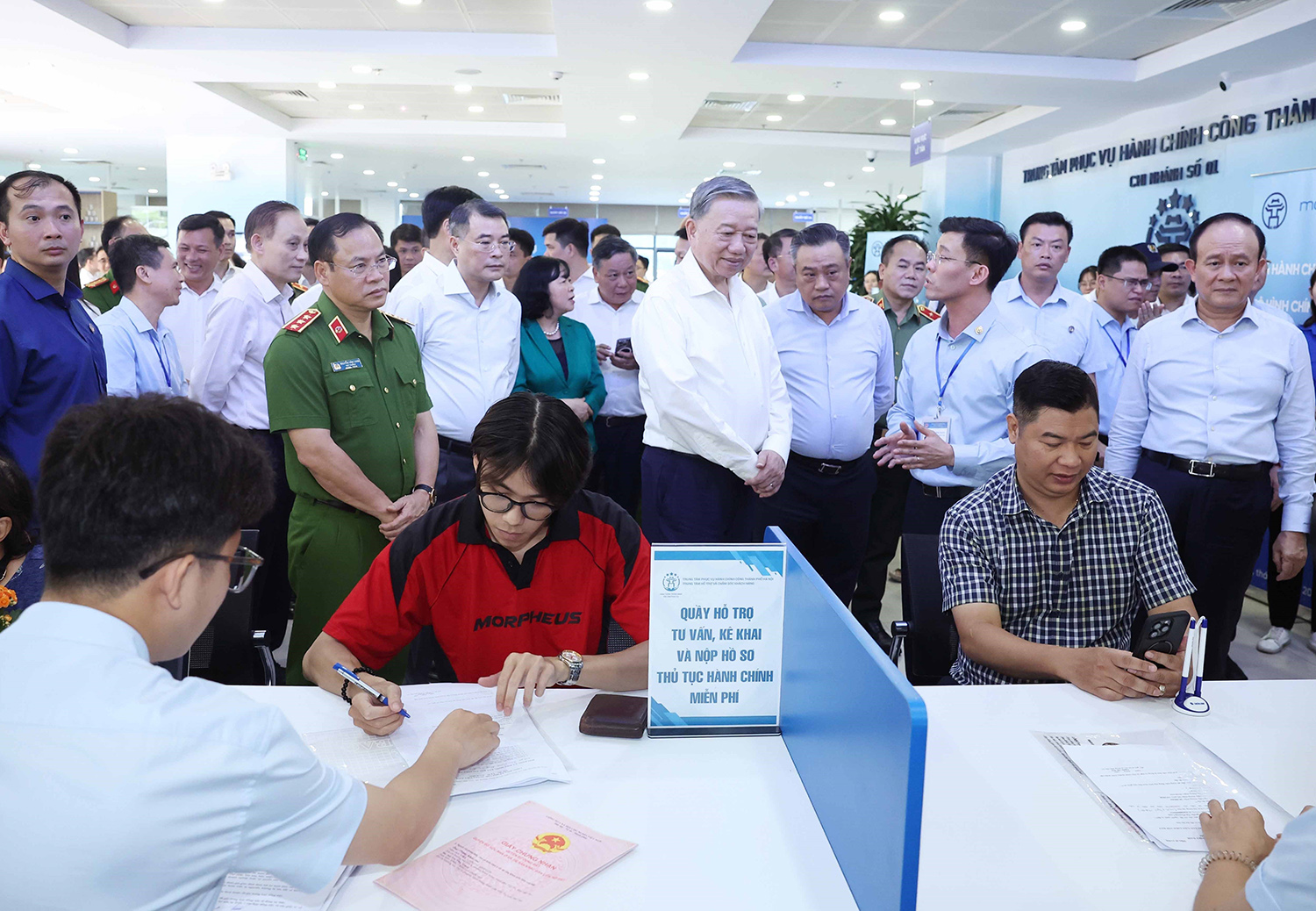
Party General Secretary To Lam inspects operations at the Hanoi Public Administrative Service Centre Photo: VNA
Communist Review - The current three-tier government organisational model (central - provincial - communal) and the policy of payroll streamlining constitute an important reform step aimed at building a streamlined political system apparatus operating with high performance, efficiency and effectiveness. However, this also poses new challenges for Party inspection and supervision work. Therefore, Party inspection and supervision agencies should change their mindset, improve organisation, apply technology and elevate the strategic level of their operations, thereby successfully fulfilling their tasks in the nation’s new era of development.
In the process of reforming the national administrative system, reorganising the government apparatus in the direction of streamlining, effectiveness and efficiency has been a major and consistent policy of the Party over many terms. Streamlining the payroll, rearranging administrative units, reorganising specialised agencies in association with clear decentralisation and delegation of authority, and strengthening power control are urgent requirements in building a socialist rule-of-law State of the people, by the people and for the people.
The three-tier government model includes the central, provincial and communal levels, and has become increasingly clearly defined during the implementation of the Resolution of the 6th meeting of the 12th Party Central Committee (October 2017) and the latest conclusions and directives of the Politburo and the Secretariat on organisational restructuring, especially after the merger of several provinces, the discontinuation of district-level administration, and the merger of commune-level administrative units. This model has created and continues to bring about profound changes in the operational methods of local governments and the cadre structure, posing new requirements for the Party’s inspection and supervision work - an important leadership function directly affecting the quality of the organisational apparatus and the operational effectiveness of the political system.
Three-tier government impacts on Party inspection and supervision
In the context of the entire Party accelerating payroll streamlining and restructuring the organisational apparatus of the political system, the establishment of the three-tier government model has comprehensively affected the Party inspection and supervision work. These impacts are both positive and challenging.
Positive impacts
First, linking inspection and supervision with decentralisation in management and administration. Clearly defining the three levels - central, provincial and communal - in the current government model helps establish specific boundaries of power, thereby enabling inspection agencies at all levels to proactively and clearly identify inspection subjects and scope, enhancing specialisation. In particular, the central level has proactively strengthened decentralisation to localities under the principle: “Localities decide, localities implement, localities take responsibility.” Along with decentralisation and delegation of authority to localities and grassroots levels, it is necessary to strengthen inspection, supervision and power control to prevent and deter possible violations.
At the central level, the Party Central Committee's Inspection Commission should focus on inspecting key and sensitive areas, such as personnel work, Party finance, public investment management, and power control in State-owned groups and corporations.
At the provincial level, the provincial Party Committee's Inspection Commission closely monitors the activities of departments and sectors, strengthening thematic inspections, inspections based on signs of violations, and public service inspections.
At the commune level, Party cells and the supervising Inspection Commission are well positioned to conduct regular oversight of grassroots officials and civil servants, particularly in areas related to public service delivery, social welfare, finance, and land management.
Second, opportunities to strengthen inspection capacity at provincial and grassroots levels. The three-tier government model creates conditions for reallocating and decentralising inspection tasks, helping provincial and communal Party Committee's Inspection Commissions enhance their proactive and independent role in inspecting subordinate Party organisations, avoiding dispersion and overlap. At the same time, the consolidation of commune-level administrative focal points reduces the number of Party cells, enabling Inspection Commissions to concentrate resources on deeper inspections instead of conducting mass inspections.
Third, strengthening the role of preventive inspection from an early stage and from afar. The three-tier government model requires inspection not only to handle violations, but also to move towards early supervision - early warning - remote prevention. The communal level - where negative phenomena are likely to arise - needs focused and targeted inspections with increased supervision frequency in order to promptly rectify violations in leadership and management work.
Negative impacts, limitations and challenges
First, the risk of excessive workload on provincial-level inspection bodies. Streamlining staffing and reducing organisational units have led to a decline in the number of inspection personnel, while the workload has remained unchanged. In many localities, members of the provincial Party Committee’s Inspection Commission are required to perform multiple roles and often lack specialised expertise. As a result, top-down inspection can be delayed and may not reflect on-the-ground realities due to insufficient information.
Second, the inspection and supervision role of communal Party Committees has become extremely important. However, many grassroots Party committees have not fully recognised the role of inspection and supervision; in some localities, inspection officials are reluctant to confront issues and are influenced by personal relationships; the capacity of grassroots officials has yet to fully meet the requirements for detecting and preventing violations.
Third, there is a lack of modern inspection tools and supporting technologies. This is an important requirement in the context where the government is rapidly shifting towards digitalisation and modern governance in order to detect and prevent violations at an early stage.
Fourth, awareness and implementation remain uneven among localities. Some localities have been slow to adapt to the two-tier local government model (provincial - communal), and remain confused in decentralising tasks and defining responsibilities between levels of government and Party organisations. As a consequence, inspection work is either shirked or duplicated, resulting in low effectiveness.
Issues arising for inspection and supervision work in the new context
First, inspection and supervision at the communal level.
After implementing mergers, streamlining the organisational apparatus and applying the two-tier local government model, the communal level has become the frontline directly associated with people’s livelihoods, handling a larger volume of work and serving as the “final point” for implementing guidelines and policies from higher levels.
This both creates opportunities for communal-level officials to become familiar with a broader range and greater complexity of work, and poses new requirements for improving their professional qualifications and expertise. In the long term, this will help continually improve the professional qualifications and expertise of communal-level officials, enabling them to better meet the requirements of their tasks in the new situation. This also requires the rapid and timely dissemination of central guidelines, without delays, ensuring that communal-level agencies and organisations promptly grasp the Party’s and State’s guidelines and policies and implement them effectively at the local levels. An important policy associated with the implementation of leadership and management work is the arrangement of communal-level leadership and management officials. Conclusion No. 177-KL/TW dated July 11, 2025 of the Politburo and the Secretariat “on continuing to build the organisation and operation of two-tier administrative units to ensure smoothness and effectiveness” allows the “flexible arrangement and appointment of capable and experienced officials able to meet work requirements”, “maintaining and improving public satisfaction, taking their satisfaction as a benchmark for performance”; arranging deputy positions appropriately in line with the spirit of Conclusion No. 187-KL/TW dated August 29, 2025 of the Politburo and the Secretariat on orientations regarding the number of deputy positions in agencies and organisations within the political system: “appropriate to reality and not applied uniformly, taking into account the specific characteristics of merged and consolidated units”. These are timely and comprehensive provisions associated with the practical implementation of restructuring the organisational apparatus of the political system.
Many documents of the Politburo and the Secretariat have also been issued in a timely manner, such as Conclusion No. 183-KL/TW dated August 1, 2025 of the Politburo and the Secretariat on actively implementing the operation of the two-tier local government model, strongly shifting the grassroots level towards proactive socio-economic management and administration, and defence and security management, which determines that it is necessary to “ensure clear responsibilities for individuals and tasks, without overlap or omission of functions and duties”; Directive No. 53-CT/TW dated October 26, 2025 of the Politburo on strengthening the Party’s leadership over the implementation of accountability by agencies, organisations and individuals in public service activities, which mentions paying due attention to supervision and inspection work; and criteria for evaluating effectiveness and people’s satisfaction regarding the accountability of agencies, organisations and individuals in public service activities. This poses requirements and tasks for the system of inspection and supervision agencies at all levels to ensure the effective implementation of the Party’s and State’s guidelines and policies in the new context, associated with the characteristics of the communal level as the level that frequently interacts with people and is directly linked to land management, commune budgets, recurrent expenditures, construction licensing, and the implementation of grassroots policies...
Second, decentralisation and delegation of authority does not necessarily mean “dispersion of responsibility”.
Party Central Committee resolutions, especially the orientation of General Secretary To Lam at the conference reviewing 2024 work and deploying 2025 tasks of the Government and local administrations (January 8, 2025), emphasised granting greater autonomy and initiative to all levels of government. However, this must go hand in hand with strict supervision and power control mechanisms to prevent the abuse of power for personal interests.
Granting greater autonomy and initiative to local governments ensures local proactiveness and creativity associated with the characteristics of regions, areas and management zones. With such proactiveness and creativity, localities are fully capable of promoting internal resources, strongly connecting with other localities and expanding cooperation activities, but this also increases local responsibility for ensuring socio-economic development, people’s livelihoods, and security, order and social safety...
From this reality, the Party’s inspection and supervision work within the three-tier government model should rebuild its network of connections, shifting from inspection that is heavily administrative and procedural in nature to inspection that is strategic, predictive and proactive in detecting potential violations at an early stage.
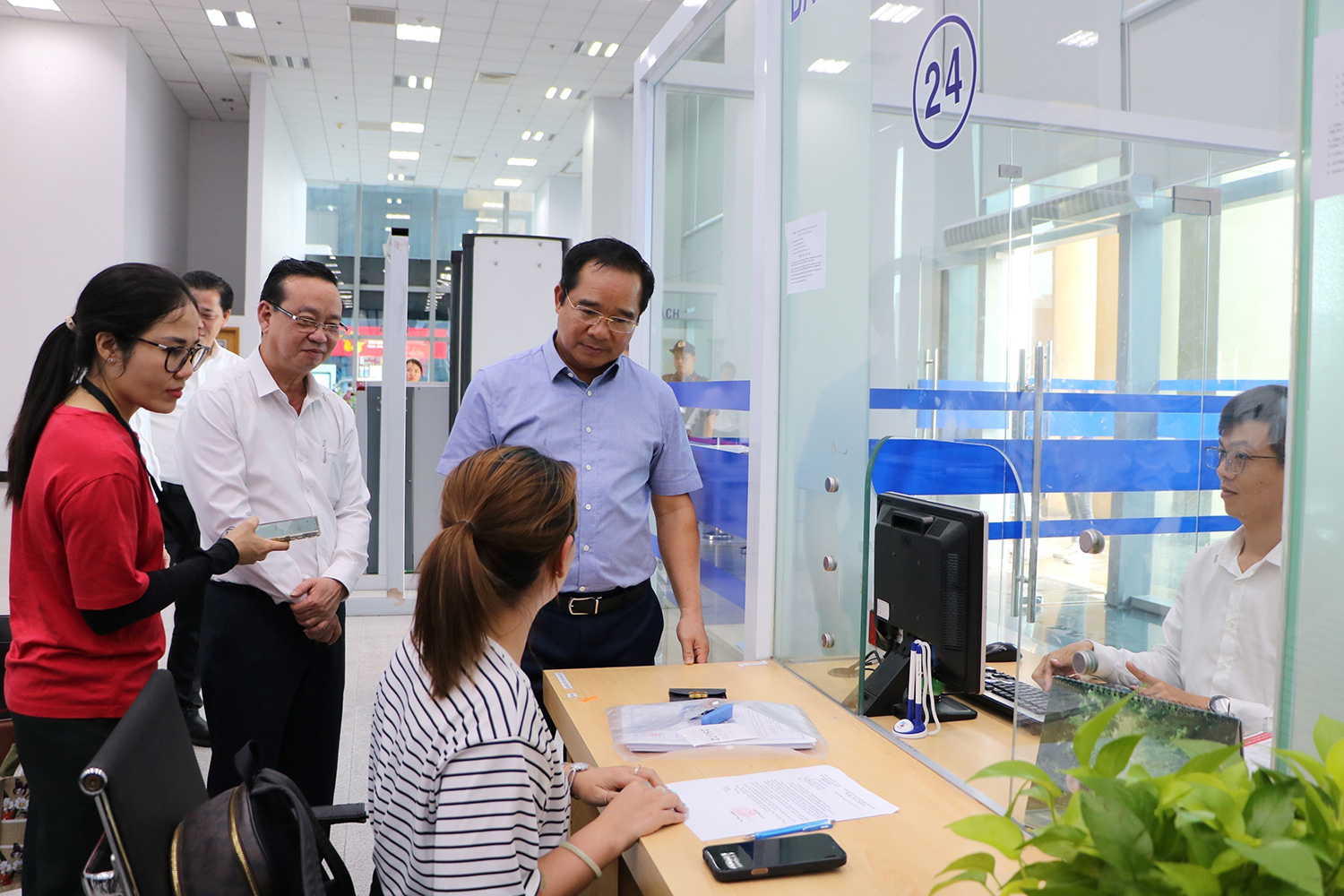
Member of the Party Central Committee and Chairman of the Ho Chi Minh City People’s Committee Nguyen Van Duoc and a working delegation conduct a survey and field inspection at the Binh Duong Ward Public Administrative Service Centre Photo: VNA
Solutions to enhance effectiveness of Party inspection and supervision amid payroll streamlining and three-tier government model implementation
General solutions
First, Party committees, Party organisations and Inspection Commissions of Party Committees at all levels should focus on effectively carrying out several key tasks. These include urgently restructuring and streamlining the organisational apparatus of Inspection Commissions at all levels in a synchronised and unified manner to meet new requirements and tasks; streamlining the apparatus together with restructuring the organisation and contingent of inspection officials at all levels to ensure sufficient qualities, competence and capability commensurate with assigned tasks.
Second, the Party Central Committee’s Inspection Commission should urgently study and review regulations in order to advise on promptly amending and supplementing Party regulations on inspection and supervision work in line with the new Party organisational model nationwide; ensuring proper authority, functions and tasks; strictly implementing the principle that wherever Party organisations and Party members operate, there must be inspection and supervision, leaving no area or field unchecked. It should advise on developing and promulgating coordination regulations between the Party Central Committee’s Inspection Commission and certain Party organisations immediately after completing projects on restructuring and streamlining the organisational apparatus.
Third, further innovation in inspection and supervision methods and approaches is needed, together with greater efforts to promote digital transformation and the application of information technology so as to enhance the quality, effectiveness and efficiency of Party inspection, supervision and disciplinary work. Proactive advice should be provided to the Party Central Committee, the Politburo, the Secretariat and Party committees at all levels to ensure the effective leadership and implementation of self-inspection and supervision within their respective localities and units. Timely reminders, warnings and preventive measures should be put in place to detect, deter and prevent violations early and from afar. Throughout the implementation process, strict adherence to the principles, methods and regulations governing the Party inspection and supervision work must be maintained.
Key issues to be addressed
First, inspection and supervision mechanisms should be further refined to align with the implementation of the three-tier government model. Stronger innovation is required in the mindset, methods and organisation of inspection and supervision across the three-level system of Inspection Commissions, in line with the guidance of Party General Secretary To Lam. Priority should be given to strengthening supervision so as to ensure that resolutions, directives and conclusions of the Party Central Committee, the Politburo and the Secretariat are implemented in a timely and effective manner and in accordance with Party guidelines and regulations. Greater attention should be devoted to the inspection and supervision of personnel arrangements and assignments under the three-tier government model, as well as to oversight of the national digital transformation process. Inspection and supervision work should be closely linked to the control of power. Effective supervisory mechanisms with early-warning and preventive capabilities should be established in order to detect and prevent violations at the grassroots level.
Efforts should be made to study, advise on, direct and guide the coordinated implementation of measures aimed at improving the quality and effectiveness of inspection and supervision by Party committees and their inspection commissions at all levels, while placing particular emphasis on enhancing the effectiveness of inspection and supervision at the Party cell level.
In the absence of the district level, the reorganisation of the Party's inspection system should be based on strengthening the central role of the provincial Party Committee’s Inspection Commission in conducting regular top-down supervision. This role should serve as an extended arm of the central authorities through early-warning systems, data analysis, periodic reporting and large-scale thematic inspections. Inspection and supervision should focus on pressing issues and matters of public concern, including state management of land, minerals, energy and food safety, thereby helping to unlock resources for local socio-economic development. Inspection and supervision efforts should continue to contribute effectively to the prevention and combat of corruption, wastefulness and other negative phenomena. Dedicated or inter-agency teams should be established to conduct inspection and supervision in sensitive and complex areas, including peri-urban communes and localities with numerous investment projects, land clearance activities and land management issues.
Second, inspection and supervision programmes should be reformed to suit the two-tier local government model. Inspection and supervision of Party committees, agencies and units should be strengthened with regard to the implementation of resolutions and conclusions of the Party Central Committee, the Politburo and the Secretariat on national development to ensure the efficient use of resources for socio-economic development in such areas as the management and use of recurrent expenditure budgets; the management and utilisation of public investment capital; the management and use of public land and buildings; state management of land resources; the management, exploitation and utilisation of natural resources, minerals and energy; land-use planning and construction; organisational restructuring; labour management and utilisation; and working-time management in the public sector. The ultimate goal is to safeguard and improve people's livelihoods.
Third, the application of information technology and integrated reporting systems should be accelerated. Comprehensive digital transformation should be vigorously promoted, and tasks required to fulfil the principle of “supervision based on data and inspection based on data” should be implemented decisively and in a coordinated manner throughout the Party Inspection sector. The Inspection Commissions at all levels should digitalise documents and update and develop databases for inspection and supervision work in accordance with the digital transformation roadmap of the Party Inspection sector. Modern technologies should be applied throughout the inspection and supervision process. Data connectivity and data-sharing mechanisms among agencies both within and outside the sector should be strengthened while ensuring information security and confidentiality. An interconnected digital platform linking all three levels of government and inspection bodies should be developed, with the aim of enabling real-time management of records relating to Party members, officials, civil servants and public employees. Budgetary, public investment and public asset data should be synchronised to provide a basis for assessing the performance of duties. Automated warning systems should also be introduced to detect irregularities in budget disbursement, planning activities and personnel transfers at the commune level.
Fourth, the capacity of inspection and supervision personnel, particularly at the provincial level, should be enhanced. Continued efforts should be made to build streamlined, strong and highly effective Inspection Commissions of Party Committees at all levels. The organisational model of the Party Inspection sector and the arrangement of inspection personnel at all levels (1) should be further refined, particularly through the implementation of the policy under which chairpersons of provincial and communal Party Committee Inspection Commissions are not local residents. Institutional frameworks should continue to be improved in order to facilitate proposals allowing higher-level Inspection Commissions to appoint, recommend or transfer chairpersons of lower-level Inspection Commissions and to approve members of lower-level Inspection Commissions in accordance with decentralisation and delegation policies. Greater awareness and understanding of new regulations, viewpoints and policies on inspection and supervision should be promoted among officials working in the Party Inspection sector. A contingent of inspection officials with strong political resolve, professional competence, legal expertise, effective digital skills and exemplary moral qualities should be developed. These officials should demonstrate initiative, courage and a willingness to assume responsibility, particularly those who have recently been assigned to commune-level and equivalent positions.
The capacity and effectiveness of Inspection Commissions of Party Committees at all levels should be strengthened to ensure consistency in professional direction and guidance along vertical lines and the effective performance of inspection and supervision functions along horizontal lines. Inspection and supervision work should be closely linked to Party-building tasks. Higher-level Party committees must fully and substantively exercise their responsibility to inspect and supervise subordinate Party organisations and Party committee members.
Under the new model, provincial-level Inspection Commissions must be sufficiently strong to “oversee the entire province while maintaining direct reach to the commune level”. Accordingly, staffing levels should be increased in a manner that ensures both comprehensive coverage of inspection and supervision areas and the availability of specialised expertise in fields such as law, Party building, public economics, investigative techniques and data analysis.
Training programmes for inspection personnel should be expanded to include practical scenarios at the commune level, particularly in areas prone to misconduct, such as land management, public investment, land clearance and budget administration. Mechanisms should also be established to protect inspection officials when performing duties that involve sensitive or contentious issues, thereby shielding them from administrative pressure and factional influence.
Fifth, specialised inspection procedures should be improved to make inspections more “focused, targeted and timely”. Rotational and periodic inspections should be conducted instead of formalistic comprehensive inspections. The planning of inspections requires a new approach, one that relies on operational data, public feedback and media reports instead of waiting for complaints or denunciations to be filed. Accountability for inspection and supervision findings must be clearly assigned to the heads of provincial- and commune-level authorities, preventing situations in which “violations are identified but no one is held responsible.”
Sixth, greater efforts should be made to disseminate information and raise awareness among Party organisations, officials and Party members about typical violations, lessons learned from the Party’s inspection, supervision and disciplinary work, as well as shortcomings and inadequacies in existing mechanisms and policies. Attention should also be given to loopholes and weaknesses in management that have been identified through inspection and supervision activities, together with the corresponding corrective and preventive measures. This would help Party organisations, officials and Party members gain a clearer understanding of the types of violations that must be avoided, thereby enhancing the awareness and sense of responsibility of Party committees, Party organisations, officials and Party members.
Conclusion
The three-tier government organisational model (central - provincial - communal) and the policy of payroll streamlining constitute an important reform step aimed at building a streamlined State apparatus operating with high performance, efficiency and effectiveness. However, this very “streamlining” also poses new challenges for the Party’s inspection and supervision work - which serve as a pillar ensuring the purity, strength and integrity of the political system.
In the new model, the supervisory distance between the central, provincial and communal levels has become greater; the implementation capacity of the communal level has been enhanced while power control remains inadequate. This requires the Party’s inspection agencies to change their mindset, improve organisation, apply technology and elevate the strategic level of supervision, thereby proactively controlling the risk of abuse of power right from the root.
Practice shows that if inspection and supervision capacity is not improved alongside apparatus streamlining, we may lose the sharpest tool for controlling power, leaving a dangerous vacuum in Party and State governance at the grassroots level.
From an overall perspective, the Party’s inspection and supervision work is not only the “right hand” of leadership, but also the “shield” protecting the Party’s ideological, moral and disciplinary foundations in the practical implementation of political tasks. In the context of restructuring and reorganising the apparatus, streamlining the payroll, and reducing the government system to only three levels, this role becomes even more vital.
Only when the Party can inspect itself in a strict, scientific and modern manner can it ensure that the reform of the organisational apparatus does not deviate from its intended direction, does not create “grey areas” in the exercise of power, and does not undermine the people’s trust in the socialist rule-of-law State of the people, by the people and for the people./.
* Deputy Head of the Party Central Committee’s Inspection Commission
(1) Plan No. 222-KH/UBKTTW dated March 24, 2025, of the Party Central Committee’s Inspection Commission on digital transformation in the Party Inspection sector.


