

Principles and methods of Party inspection and supervision of leadership and direction in land management and use
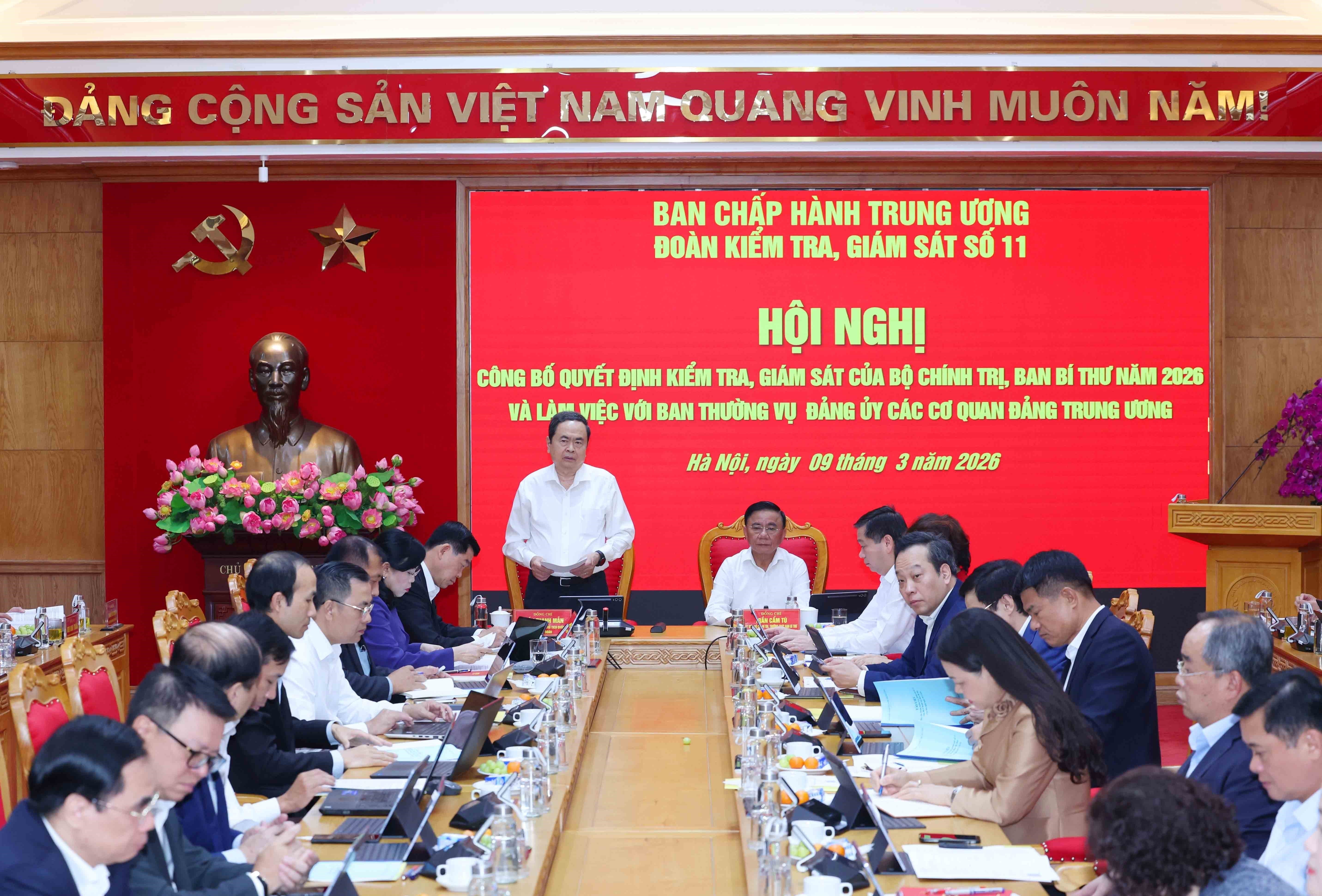
Inspection and Supervision Team No. 11 of the Politburo and the Secretariat, headed by Politburo Member and Chairman of the National Assembly Tran Thanh Man, convenes a conference to announce the Politburo’s and Secretariat’s 2026 inspection and supervision decisions concerning the Standing Board of the Party Committee of Central Party Agencies Photo: Vietnam News Agency
Communist Review - Strengthening and properly applying the Party's principles and methods for inspecting and supervising the leadership and direction of land management and land use contribute to the strict control of power, the early detection and prevention of violations, the strengthening of discipline in the Party and the political system, and the building of a socialist rule-of-law state in Vietnam that is truly of the people, by the people, and for the people.
Principles of inspection and supervision
The Party’s inspection and supervision work is of great significance. It aims to accurately assess the strengths of Party organisations and Party members in order to promote them, while also detecting and clarifying violations and shortcomings so that they can be rectified, remedied, and dealt with rigorously. It also facilitates the timely identification of loopholes and inadequacies in mechanisms, policies, and laws, thereby making recommendations to competent authorities for the promulgation of new regulations or the revision of existing ones, while enhancing the effectiveness and efficiency of state management of land, natural resources, and environment. At the same time, it helps safeguard the interests of the State and the lawful rights and interests of agencies, organisations, and individuals.
Inspection and supervision of leadership and direction in land management and use are essential to ensuring the effectiveness of the Party’s leadership and the State’s governance activities. Land is both a development resource and a domain that presents numerous challenges to political integrity, public-service ethics, and mechanisms for power control. Therefore, inspection and supervision must adhere to a comprehensive, rigorous, and consistent system of political, legal, and ethical principles.
Party committees at all levels, particularly their standing boards, must directly lead and oversee inspection and supervision rather than delegating “full responsibility” to specialised agencies. Every inspection and supervision activity must reflect the Party’s leadership, political responsibility, and consistency in strategic orientation. It must also satisfy the following requirements:
Political and organisational principles: Inspection and supervision are conducted not only to detect violations but also to assess the implementation of Party resolutions in the land sector, particularly major policies such as Resolution No. 19-NQ/TW, dated October 31, 2012, adopted by the 6th Plenum of the 11th Party Central Committee, on “Continuing the renewal of land policies and laws during the period of accelerated comprehensive national renewal, creating a foundation for our country to basically become a modern-oriented industrialised country by 2020”. For the first time, the Party identified land as a development resource while simultaneously affirming it is subject to unified state management and ownership by the entire people, with the State acting as the representative owner. This orientation established the need for power control in land allocation, land lease, and land-use conversion, together with the accountability of leaders. It provided the basis for inspection commissions at all levels to lead the inspection and supervision of Party organisations and Party members in implementing the Party’s guidelines and regulations as well as the State’s laws on land.
With Resolution No. 18-NQ/TW, dated June 16, 2022, adopted by the 5th Plenum of the 13th Party Central Committee, on “Continuing to reform and improve institutions and policies and enhancing the effectiveness and efficiency of land management and use, creating momentum for our country to become a high-income developed country”, the Party further clarified its orientation by requiring land resources to be fully mobilised as a central driver of sustainable development. The Resolution reaffirmed the need for stricter power control and severe handling of “corruption and negative practices in land management and use”; while making publicity, transparency, and land data digitisation mandatory. It thereby established a direct political and legal basis for the design of digital models for inspection and supervision and for the analysis of political, economic, and social risks related to land issues.
The Politburo’s Conclusion No. 14-KL/TW, dated September 22, 2021, on “Encouraging and protecting dynamic and innovative cadres who dare to think and dare to act for the common good”, represents a balance between power control and the protection of innovative initiatives. In addition, inspection and supervision in the land sector must clearly distinguish between violations committed for personal gain and mistakes arising from breakthroughs and innovations for the common good. This conclusion suggests an important principle: inspection should not be used to “tie the hands of officials”, but rather to protect those who dare to assume responsibility and dare to act in the interests of the country. It also provides a basis for Party committees at all levels and their inspection commissions to adopt more humane and impartial methods of inspection and supervision.
On November 24, 2025, the Politburo issued Conclusion No. 218 on “Perspectives and policies for handling violations of land laws occurring from the time the 2013 Land Law took effect until before the 2024 Land Law came into force”, with the objective of ensuring fairness and objectivity in disciplinary reviews and identifying the root causes of violations in order to adjust policies in line with practical realities. Accordingly, the outcomes of inspection and supervision must reflect the effect of Party leadership, contributing to policy adjustments, and enhancing implementation capacity, rather than merely focusing on the handling of violations.
The principle of democratic centralism constitutes the organisational foundation of the Party and must be upheld throughout the entire inspection process: Collective decision-making must be combined with individual responsibility; conclusions must be based on evidence rather than speculation; and democratic discussion and consensus must be achieved on the basis of dossiers, evidence, and legal provisions. At the same time, transparency of information and the appropriate disclosure of results should be ensured in order to strengthen public trust and enhance deterrence and prevention.
Legal and administrative principles: The Party’s inspection and supervision activities in the land sector must be grounded in the socialist rule of law, particularly the Land Law adopted by the National Assembly on January 18, 2024, and effective from January 1, 2025. Inspection bodies must thoroughly understand the new regulations concerning integrated planning, public auctions, market-based land pricing, land recovery, compensation, resettlement, and land-use rights as transferable assets. Inspection activities must identify the extent of legal compliance and promptly detect “legal gaps” so as to recommend improvements to mechanisms and policies.
The principle of “no prohibited zones and no exceptions” must become a permanent standard. All land-related violations, regardless of the level at which they occur, must be dealt with resolutely, while self-inspection, self-detection, and self-remediation should be encouraged. Inspection and supervision conclusions must clearly specify the nature of violations, identify those responsible, and recommend appropriate remedial measures. They must also guarantee the lawful rights of organisations and individuals concerned to lodge complaints and provide explanations.
Ethical principles and public-service responsibility: Linking inspection work with the cultivation of public service ethics and culture requires officials engaged in land inspection and supervision to demonstrate genuine integrity, courage, honesty, objectivity, and independence from personal interests or relationships. Every inspection or supervision serves as a test of political ethics and the culture of power. Only when inspection officials are incorruptible and impartial can inspection outcomes be objective, accurate, persuasive and have educational value.
Combining periodic inspection with regular supervision: This principle ensures proactiveness and continuity. Early supervision helps identify violations at their source, while periodic inspections facilitate comprehensive reviews and evaluations. A shift must be made from a model of “post-inspection handling” to one of “early supervision, early warning, and prevention from afar”, using digital data, land maps, and public feedback as tools for automated warning systems. Political and ethical accountability of the heads of Party committees, authorities, and land management agencies must be upheld whenever violations occur within their areas of responsibility. This principle clarifies individual accountability, prevents “dilution of responsibility”, while fostering a culture of acknowledging mistakes and taking corrective action at an early stage.
Methods of inspection and supervision
If “principles” constitute the foundation, “methods” provide the means of implementation. Inspection and supervision methods in the field of land management and use must be applied in a scientific, systematic, and digitally adaptive manner so as to ensure political, legal, and technical soundness while enhancing forecasting and preventive capacities. The conduct of an inspection or a supervision should be based on several key methods:
Organisational and procedural methods: First, a comprehensive understanding of the situation must be obtained through the collection of all relevant documents, including planning dossiers, cadastral maps, land allocation and lease decisions, land-use conversion decisions, auction records, valuation documents, financial obligation records, and feedback from citizens and the press. Digitised databases, electronic land management systems, and GIS-based cadastral maps should be utilised to identify changes, discrepancies, overlaps, and unusual land-use conversions.
Second, indicators of violations should be analysed through financial flows, tax data, business registration information, and urban planning records in order to detect anomalies, such as frequent changes in land-use rights, asset values, or connections between enterprises and public officials.
Third, attention should be focused on clarifying the leadership and direction by Party committees; the responsibilities of Party organisations and their leaders; and whether decision-making processes comply with the law and Party resolutions. Minutes should be prepared, and open dialogues should be held in order to avoid one-sided reporting.
Fourth, inspection findings should be compared with Party regulations and State laws so as to clearly determine the nature and severity of violations, their consequences, and the responsibilities involved. Recommendations for handling and remediation should be proposed, while electronic records should be maintained to facilitate follow-up and supervision of the implementation of inspection and supervision conclusions.
Professional methods: Vested interests and flows of benefits should be analysed by tracing the entire chain of administrative actions and decisions relating to land management in order to identify patterns of vested interests: from planning and land allocation to valuation and licensing. Unusual connections between individuals with authority and benefiting enterprises should be detected, as these often constitute typical indicators of conflicts of interest and policy manipulation. Subsequently, market land prices should be compared with the State pricing framework through the application of dual-valuation models that combine transaction data, local price information, and national land-price indices in order to quantify losses to the State budget.
Misconduct in land management and use is often associated with manifestations of the corruption of power and the abuse of authority for personal gain. Therefore, assessments should address not only economic consequences but also political, ideological, and social-trust impacts. On that basis, preventive measures should be proposed, including greater transparency in land information, cadre rotation, asset-control mechanisms, and the promotion of a culture of integrity among public officials and civil servants.
Methods of examination and verification: Examination and verification constitute the most important of the five fundamental methods employed in the Party’s inspection and supervision work. This method may be understood as the process through which inspection bodies identify, collect, examine, review, evaluate and utilise evidence, while analysing information and documents gathered in relation to the subjects under inspection. It also involves analysing the interconnections and consistency among various sources of information and between such information and the inspection case itself, in accordance with Party principles and working methods, in order to establish the truth and accurately determine the essence of the information concerned. Through this process, it can be demonstrated whether the inspected organisation or individual has committed shortcomings or violations, thereby ensuring that conclusions and disciplinary decisions are fair, accurate, and timely. Examination and verification must provide objective, prudent, honest, and accurate assessments of achievements, shortcomings, violations, their nature and severity, adverse consequences, causes, and aggravating or mitigating circumstances, thereby ensuring appropriate disciplinary measures applicable to Party organisations and members.
Information concerning indications of violations in the land sector originates from multiple sources and appears in various forms, differing in scope, nature, and severity. One of the most important channels for detecting and identifying signs of violations is regular supervision, supplemented by information obtained from inspection, audit, and investigative agencies, as well as from the press, public opinion, citizens’ feedback, petitions, and denunciations. Effective analysis, screening, classification, and synthesis of information must therefore be conducted to determine whether there are sufficient grounds for identifying indications of violations.
Such information and documentation should then be examined against specific regulations of the Party, the State, and the agencies or units subject to inspection and supervision in order to establish whether Party organisations or members have committed violations.
Practical experience demonstrates that when Party committees and their inspection commissions proactively conduct regular supervision while integrating information from other channels, indications of violations can be identified more effectively, thereby facilitating the accurate selection of subjects and contents of inspection and ensuring that inspection and supervision decisions are appropriate and targeted.
As in other sectors, examination and verification in the land sector must adhere to the fundamental principles governing examination and verification activities. These activities must be carried out throughout the entire inspection and supervision process and in accordance with Party working principles and methods, particularly the proper implementation of democratic centralism, self-criticism, and criticism.
In practice, when these principles and methods are thoroughly understood and properly applied in inspection and supervision activities, the detection of violations, shortcomings, and loopholes or obstacles in mechanisms and policies becomes significantly easier.
A comparison of Party and State regulations with practical experience in inspection and supervision indicates that when an inspection or supervision activity concerning leadership and direction in land management and use is conducted in accordance with the correct principles and methods, while fully complying with Party regulations on inspection, supervision, and Party discipline, as well as relevant State regulations, even the most complex cases can be examined and ultimately resolved./.


