

Inspections of Party organisations for signs of violations: A key tool for upholding Party discipline
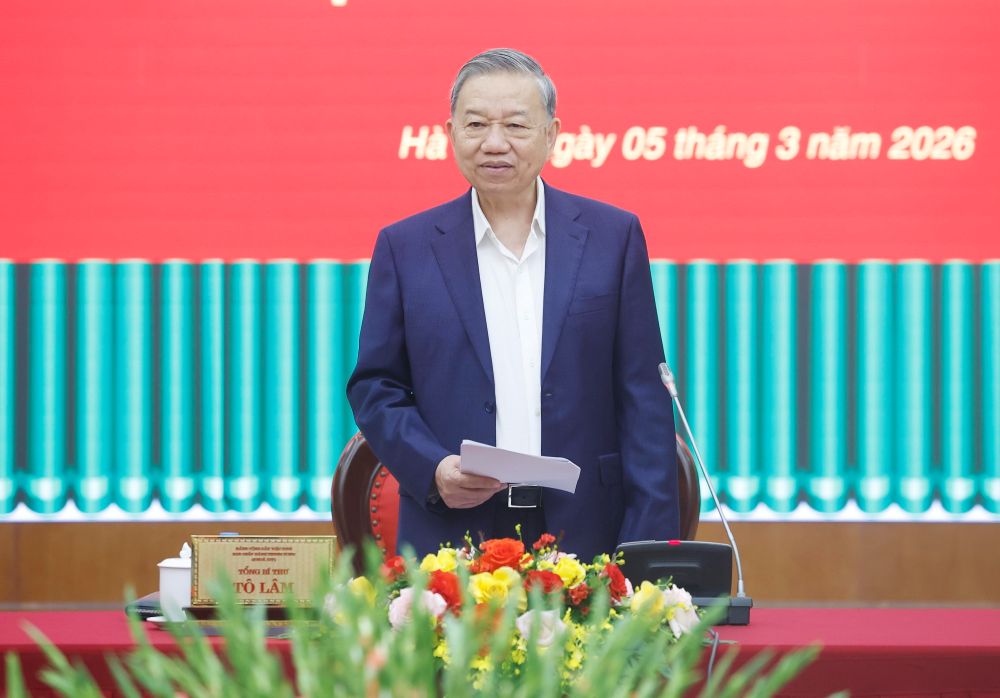
General Secretary To Lam works with the Party Central Committee’s Inspection Commission Photo: Vietnam News Agency
Communist Review - Inspecting Party organisations when there are signs of violations is a key task that directly contributes to upholding Party discipline and rules, while strengthening the integrity and effectiveness of agencies and organisations throughout the political system. In recent years, under the close leadership of the Party Central Committee, the Politburo and the Secretariat, and directly under the guidance of the General Secretary, inspections of Party organisations and members showing signs of violations have achieved significant results. These efforts have enhanced the capacity and combativeness of Party organisations, contributed positively to the fight against corruption, misconduct and wastefulness, and helped safeguard democracy and discipline.
Party inspection, supervision and disciplinary work constitute one of the Party’s leadership functions, reflecting the revolutionary nature, vanguard role, exemplary character, and organisational and operational principles of the Communist Party of Vietnam. Among these tasks, inspecting Party organisations when there are signs of violations is of central importance and serves as a principal means of preventing and combating misconduct, moral and ideological degradation, and other negative phenomena, while strengthening the integrity and effectiveness of Party organisations.
In recent years, under the direct leadership of the Party Central Committee, the Politburo and the Secretariat, and particularly the close guidance of General Secretary To Lam, Head of the Central Steering Committee for the Prevention and Control of Corruption, Wastefulness and Negative Phenomena, the Party’s inspection, supervision and disciplinary work has undergone a breakthrough transformation in terms of thinking, methods and practical effectiveness. Numerous complex and long-standing cases involving Party organisations that had attracted public concern have been uncovered, promptly inspected and dealt with in a strict and impartial manner. These efforts have left a strong impression and won broad support from Party members, officials and the public.
Practice has shown that inspections of Party organisations for signs of violations are not merely a matter of technical procedures or professional expertise. They also constitute a resolute political, ideological and organisational struggle that directly affects the Party’s prestige, leadership capacity and combativeness. As the effort to build and strengthen the Party and the political system enters a new stage, increasingly higher demands are being placed on inspections of organisations showing signs of violations. This requires strong political resolve and a firm commitment to ensuring that inspections are conducted promptly, effectively and rigorously, targeting the right individuals and organisations and addressing the correct violations.
Leadership and direction in inspecting Party organisations for signs of violations, and some typical cases of misconduct
During the 13th National Party Congress term, in response to the requirements of comprehensively strengthening and rectifying the Party and resolutely combating degradation, “self-evolution” and “self-transformation”, the Party Central Committee’s Inspection Commission has played a prominent role in the Party’s inspection, supervision and disciplinary work, particularly in conducting inspections of Party organisations showing signs of violations. This key task has direct significance in maintaining the Party’s discipline and ensuring the strict enforcement of its rules and regulations.
The Central Inspection Commission has focused on researching, drafting, issuing and advising the Party Central Committee, the Politburo and the Secretariat on the promulgation of numerous important regulations, rules, programmes and guidelines on Party inspection, supervision and disciplinary enforcement. These documents have been designed to ensure scientific consistency, practicality and suitability to real-world conditions, with particular emphasis on refining the principles, methods and procedures for inspection and supervision. They serve both as tools for education, prevention and deterrence, and as a basis for detecting and strictly handling violations committed by Party organisations and members. They have also created favourable conditions for Party committees, Party organisations and inspection commissions at all levels to carry out inspection and supervision tasks in a consistent manner from the central to grassroots levels.
The Central Inspection Commission has focused on directing and guiding inspection commissions at all levels to promptly detect and address violations in localities and sectors prone to misconduct and corruption, particularly those attracting significant public concern. Efforts have been made to prevent the emergence of “hotspots” and to ensure that violations do not accumulate, persist, spread or result in serious consequences.
Many complex cases involving multiple Party organisations and members have been inspected, concluded and handled in a strict and impartial manner, reaffirming the principle that “all Party organisations and Party members are equal before Party discipline”. This has clearly demonstrated the Party’s commitment to “no prohibited zones and no exceptions”, ensuring strict Party discipline and order, strengthening unity and cohesion within the Party, and reinforcing public trust.
The Central Inspection Commission has guided and directed inspection commissions at all levels to stay closely aligned with practical realities, maintain a firm grasp of developments and accurately anticipate emerging trends. It has identified inspection and supervision tasks as requiring a comprehensive and coordinated approach, closely linked to addressing issues of concern to officials, Party members and the public.
The Commission has continuously renewed its thinking on Party inspection, supervision and discipline, while respecting objective realities and maintaining consistency and steadfastness in strategic direction. It has promoted the coordinated implementation of inspection and supervision under the principle that “supervision must be broad” and “inspection must be focused and targeted”. Particular emphasis has been placed on supervision as a means of providing timely reminders and warnings, helping to proactively prevent violations at an early stage and from afar.
Since the beginning of the 13th National Party Congress term, inspection commissions at all levels have conducted inspections into signs of violations involving 13,612 Party organisations. The inspections concluded that 8,766 organisations had committed violations, with disciplinary measures imposed on 1,156 Party organisations.
The Central Inspection Commission alone inspected 78 Party organisations. Through these inspections, it identified and concluded violations and shortcomings, and decided disciplinary action against 259 Party organisations. It also recommended that the Politburo and the Secretariat impose disciplinary measures on 57 Party organisations, while requesting lower-level Party organisations to take disciplinary action against numerous related Party organisations and members.
Inspection activities focused on prominent issues and sectors vulnerable to corruption and misconduct that have generated public concern and attracted significant public attention. These included personnel work; the management and use of public finances and assets; land, natural resources and minerals; the securities sector; the procurement of medical equipment and supplies; as well as the organisation and implementation of bidding packages and investment projects.
Practical experience from inspections conducted when signs of violations are detected shows that Party organisations commonly commit the following violations:
First, violations of the principle of democratic centralism and working regulations
Inspection findings indicate that some Party organisations have violated the principle of democratic centralism, as well as regulations governing the formulation, issuance and implementation of working rules. Such violations include failing to strictly comply with working regulations in organising meetings, holding discussions, and issuing resolutions and conclusions; adopting policies that are inconsistent with resolutions, directives and regulations of higher authorities or with the law; and allowing situations in which “an individual makes decisions on behalf of the collective” or “the collective legitimises individual decisions”. These practices distort the Party’s collective leadership principles and undermine the nature of Party leadership.
Second, violations in personnel work
This is one of the most prominent and complex areas of concern, often resulting in long-term consequences. Common violations include: 1- abuse of authority, localism, favouritism and the promotion of personal or factional interests in personnel planning, appointments, rotations and assignments; and 2- a lack of transparency and objectivity in the assessment and evaluation of officials, leading to inappropriate appointments and personnel placements.
Such violations undermine the credibility of Party organisations and erode public trust.
Third, violations in leadership and direction of socio-economic development, and the management of land, natural resources and minerals
Some Party organisations have shown weak leadership and inadequate inspection and supervision, allowing violations to occur during implementation. These violations often involve the formation of vested-interest groups, systematic misconduct, and collusion between state agencies and businesses or contractors to legitimise procedures and circumvent legal regulations.
Numerous cases involving land management, mineral resources, public investment, and public finance and budgeting have resulted in serious consequences, posing risks of significant losses to the state budget and creating conditions for corruption, wastefulness and other negative practices to emerge.
Fourth, violations in inspection, supervision, and the prevention and combat of corruption, wastefulness and negative phenomena
A considerable number of Party committees and standing committees of Party organisations have failed to fulfil their responsibilities, showing leniency and reluctance to address shortcomings. As a result, violations within their organisations were not detected, prevented or addressed in a timely manner.
Lessons learned from inspections of Party organisations showing signs of violations
First, upholding principles, maintaining Party character and combativeness, and adhering to the principle of “no prohibited zones and no exceptions”
One of the direct causes of serious violations committed by some Party organisations has been weak leadership, violations of the principle of democratic centralism, and, in some cases, the reduction of this principle to a mere formality. Collective decision-making mechanisms have at times been misused to legitimise individual will and interests. In certain cases, leading officials seriously violated the principle of democratic centralism and working regulations, intervening in and directly directing actions that contravened Party regulations and the law. As a result, some Party organisations fell into disunity, abuse of power and authoritarian practices.
In particular, the principle of “no prohibited zones and no exceptions” has been translated into concrete action through the inspection, review of responsibility and disciplinary measures imposed on numerous Party organisations.
The key lesson is that, for inspection work to serve as an effective deterrent, it must be carried out with the courage to confront the truth, free from the influence of vested interests, and without leniency, favouritism or avoidance of responsibility.
Second, proactively detecting issues early and conducting timely inspections to prevent violations at an early stage and from afar
In some cases, violations within Party organisations were not detected promptly and signs of misconduct were not identified in a timely manner. As a result, efforts to prevent and stop violations at an early stage and from afar were not sufficiently effective. By the time inspections and disciplinary measures were carried out, many cases had already become serious, causing significant consequences and resulting in disciplinary action against numerous Party organisations and members. In some instances, violations first emerged during personnel planning and appointment processes, but Party committees and inspection bodies failed to intervene promptly. By the time land management, public investment and financial management systems had become extensively influenced by misconduct, addressing the violations proved far more difficult and the consequences far more severe./.


