

Putting the new spirit set forth in the documents of the 14th National Party Congress into practice
Party General Secretary To Lam works with the Standing Board of the Hai Phong Municipal Party Organisation on the results of leadership, direction, organisation of the study, dissemination, communication and implementation of the resolutions of the 14th National Party Congress Photo: Vietnam News Agency
Communist Review - The 14th National Congress of the Communist Party of Vietnam is not only a major political event marking the conclusion of a Party term, but also a milestone reflecting a new stage in the Party’s strategic thinking and vision for national development. The new spirit set forth at the Congress represents the country’s strong aspiration for progress, a comprehensive commitment to innovation, and a determination to strengthen the Party’s leadership and governing capacity. At the same time, it seeks to mobilise the combined strength of the entire nation. This spirit provides an important foundation for shaping a new development model, improving the effectiveness of national governance, and creating fresh momentum for Vietnam to advance rapidly and steadily in the nation’s new era of development.
The 14th National Party Congress concluded with great success, marking a new stage in the Party’s theoretical thinking and strategic vision for the cause of national construction and defence in the new development period.
The Congress was an event of special political significance, as it not only provided a comprehensive review of the country’s development achievements and experiences over a period marked by tremendous efforts and accomplishments, but also set out long-term strategic orientations, laying an ideological foundation and a course of action for the entire Party and people in the next stage of the Vietnamese nation’s development.
Defined as a Congress of strong and comprehensive renewal, the 14th National Party Congress marked a breakthrough in development thinking, strategic vision and the Vietnamese nation’s aspiration for progress. At the same time, it reaffirmed the Party’s mettle, wisdom and steadfast political resolve in formulating strategic policies aimed at ensuring the country’s rapid and sustainable development.
The documents submitted to the Congress were prepared with great care and scientific rigour, representing the collective wisdom of the entire Party and people. They consistently inherit the fundamental viewpoints and guiding principles affirmed at previous Party Congresses, while also reflecting new developments in theoretical thinking that correspond to the objective requirements of the country’s development in the new context.
A notable feature of the 14th Congress documents is their strong emphasis on action and implementation, highlighting the effectiveness of policy execution and closely linking strategic goals with practical measures. They place development outcomes and public satisfaction at the centre of assessing leadership capacity and the effectiveness of governance.
In his report on the documents submitted to the Congress, Party General Secretary To Lam underscored that the Political Report embodies the wisdom and strength of the people, reflecting the harmony between the Party’s will and the people’s aspirations. It truly serves as a “guiding beacon” and a “handbook for action” for the entire Party, people and armed forces(1).
Vietnam’s revolutionary experience shows that the value and vitality of the 14th National Party Congress documents lie not only in the system of viewpoints and orientations they establish, but above all in their effective implementation.
The documents can truly fulfil their guiding role only when they are translated into appropriate policies and guidelines and implemented in a coordinated and effective manner. Their impact is ultimately reflected in tangible progress in economic, cultural and social development, the safeguarding of national defence and security, and the continued improvement of the people’s living standards.
Therefore, a thorough understanding and internalisation of the core contents and new spirit of the 14th National Party Congress documents are of particular importance. This is a matter of both understanding and action, aimed at ensuring consistency between thinking and practice, and between policy orientations and their implementation.
On that basis, it is essential to harness the combined strength of the entire Party, people and armed forces to swiftly bring the resolutions of the 14th National Party Congress to life, turning it into a powerful driving force for the nation’s steady and vigorous advance in the new era. This will contribute to the successful achievement of the country’s development goals by 2030, when the Communist Party of Vietnam marks its centenary (1930–2030), and to the realisation of the development vision for 2045, commemorating the 100th anniversary of the founding of the Democratic Republic of Vietnam, now the Socialist Republic of Vietnam (1945–2045).
First, the spirit of strong, synchronous and effective renewal
Renewal continues to be identified as an imperative for development and an objective necessity in the context of intensifying strategic competition, shifts in the global economic structure, and the profound impact of the new industrial revolution. Addressing the Congress, Party General Secretary To Lam emphasised “The spirit of ‘renewal’ is a requirement of the times. Without renewal and reform, there can be no breakthrough, no competitiveness and no development. We must continue to renew our thinking, renew our development model and growth model, and renew our methods of organisation and implementation, so that the correct policy line is translated into concrete results in people’s lives.”(2)
A new development in the 14th National Party Congress lies in its approach to renewal at a deeper level, calling for fundamental changes in development thinking and in the operating methods of the entire political system. This involves a shift from an administrative management mindset, characterised by a heavy reliance on directives and direct intervention, to a governance-oriented and development-enabling approach, in which the State plays the role of providing strategic direction, creating a favourable environment, unlocking, allocating and effectively managing resources, and ensuring the efficient operation of the administrative system and the socialist-oriented market economy. At the heart of this spirit of renewal is the principle of measuring success by practical outcomes, with productivity, quality, investment efficiency, competitiveness and the people’s satisfaction serving as key criteria for assessing leadership capacity, governance effectiveness and implementation performance.
The documents of the 14th National Party Congress clearly reflect a new advance in the Party’s development thinking by identifying science and technology, innovation and digital transformation as the primary drivers of the new growth model. They regard the improvement of modern institutions and the development of high-quality human resources as decisive foundations, while emphasising green and sustainable development, the circular economy, and proactive adaptation to climate change as essential requirements of the new development model. At the same time, the efficient use of resources and labour productivity are established as the principal indicators of growth quality and national competitiveness.
In the spirit of the 14th National Party Congress, renewal is not limited to supplementing viewpoints or making isolated policy adjustments. It must be implemented in a coordinated manner, from awareness to action, from the central to the local levels, and from policy making to implementation. Only when the spirit of renewal truly takes root, linking individual and collective responsibility to concrete outcomes, while upholding discipline, order and practical effectiveness, can the strategic decisions of the 14th National Party Congress fully realise their value, generate tangible changes in practice, and meet the requirements of the country's rapid and sustainable development in the new period.
Second, the spirit of making national interests and the people's well-being the highest objective
The 14th National Party Congress clearly and consistently reaffirmed the principle of making national interests and the people's well-being the supreme objective and the primary point of reference throughout the process of formulating and implementing the country's development policies.
This reflects a new development in the Communist Party of Vietnam’s theoretical thinking and demonstrates the creative application of Marxism–Leninism and Ho Chi Minh Thought to Vietnam’s specific conditions in the new stage of development.
Accordingly, policies and guidelines are assessed not merely in terms of economic growth rates or economic efficiency. Above all, they must be directed towards the comprehensive improvement of the people's material and spiritual well-being, the strengthening of public trust, the promotion of equity and social progress, and the creation of development opportunities for all sections of society, guided by the principle of “leaving no one behind” in the development process.
This spirit reflects an important shift from a development mindset focused primarily on economic growth to one centred on comprehensive, balanced and sustainable development, in which people are placed at the centre, as both the central actors and the driving force of development. National interests are viewed in a dialectical relationship with the interests of the people, reflecting the nature of our system, whereby all development achievements must serve the people, improve their quality of life, and ensure the conditions for their all-round development.
At the same time, the 14th National Party Congress emphasised the organic unity between the goal of economic development and the requirements of safeguarding national defence and security, and maintaining independence, sovereignty and territorial integrity. These are regarded as prerequisites for protecting national interests and creating a peaceful and stable environment for long-term development.
This reflects the Party’s strategic vision in closely integrating the tasks of national construction and national defence, and in combining economic growth with social progress, equity and improvements in the people's quality of life.
On that basis, the spirit of making national interests and the people's well-being the highest objective serves as a guiding principle throughout the processes of policy formulation and implementation, ensuring that the country's development remains both on the right course and sustainable, in line with the nature and goals of the socialist system chosen by the Party and the Vietnamese people.
Third, the spirit of self-reliance, self-strengthening, self-confidence and national pride - the foundation of Vietnam’s endogenous strength in the new context
The 14th National Party Congress continued to reaffirm and elevate the spirit of self-reliance, self-strengthening, self-confidence and national pride as a core value and a source of endogenous strength of decisive importance to the country’s rapid and sustainable development amid increasingly complex and unpredictable regional and global developments. This spirit is not merely a traditional value rooted in history; it is also a strategic development principle that reflects the very process through which the Vietnamese nation has survived, grown and matured throughout its history of nation-building and national defence. Throughout every historical period, although Vietnam has not possessed significant advantages in terms of territorial size or material resources, Vietnam has consistently drawn upon a distinctive source of endogenous strength. This strength has been forged through the will for independence and self-determination, the spirit of solidarity, resilience and fortitude, and a profound confidence in its own capacity for self-reliance and creativity.
Historical experience has demonstrated that it is precisely the spirit of self-reliance and self-strengthening that has enabled Vietnam to overcome its most severe challenges, from struggles against foreign aggression and the fight for national independence to the process of national construction, development and international integration. It is a journey through which the nation has continually affirmed its identity and strength, refusing to yield to external pressures while effectively mobilising its internal resources and effectively leveraging external resources to build and strengthen its position. Confidence in its wisdom, mettle and chosen path of development, together with a profound pride in its historical traditions, cultural heritage and achievements, has formed a solid spiritual foundation and a powerful source of motivation driving the nation forward.
In the new context, characterised by increasingly intense strategic competition among nations, growing uncertainty, and ever-higher demands for rapid and sustainable development, the 14th National Party Congress placed particular emphasis on fostering the spirit of self-reliance and self-strengthening in tandem with proactive and active international integration. Self-reliance and self-strengthening do not mean isolation or self-imposed seclusion. Rather, they entail building sufficiently strong endogenous capacities to adapt proactively, enhance resilience to external shocks, and effectively seize the opportunities presented by international integration to advance national development.
The spirit of self-confidence and national pride, grounded in a proper understanding of the country's position, potential and development prospects, is an important prerequisite for strengthening political resolve and maintaining independence and self-reliance in the formulation and implementation of development policies.
Accordingly, the 14th National Party Congress elevated the spirit of self-reliance, self-strengthening, self-confidence and national pride to the level of a foundational strategic orientation. Its purpose is to awaken and maximise the nation’s endogenous strength, creating a powerful source of spiritual motivation for the entire Party and people to steadfastly overcome all difficulties and challenges and realise the aspiration of building a prosperous and happy country in the new era.
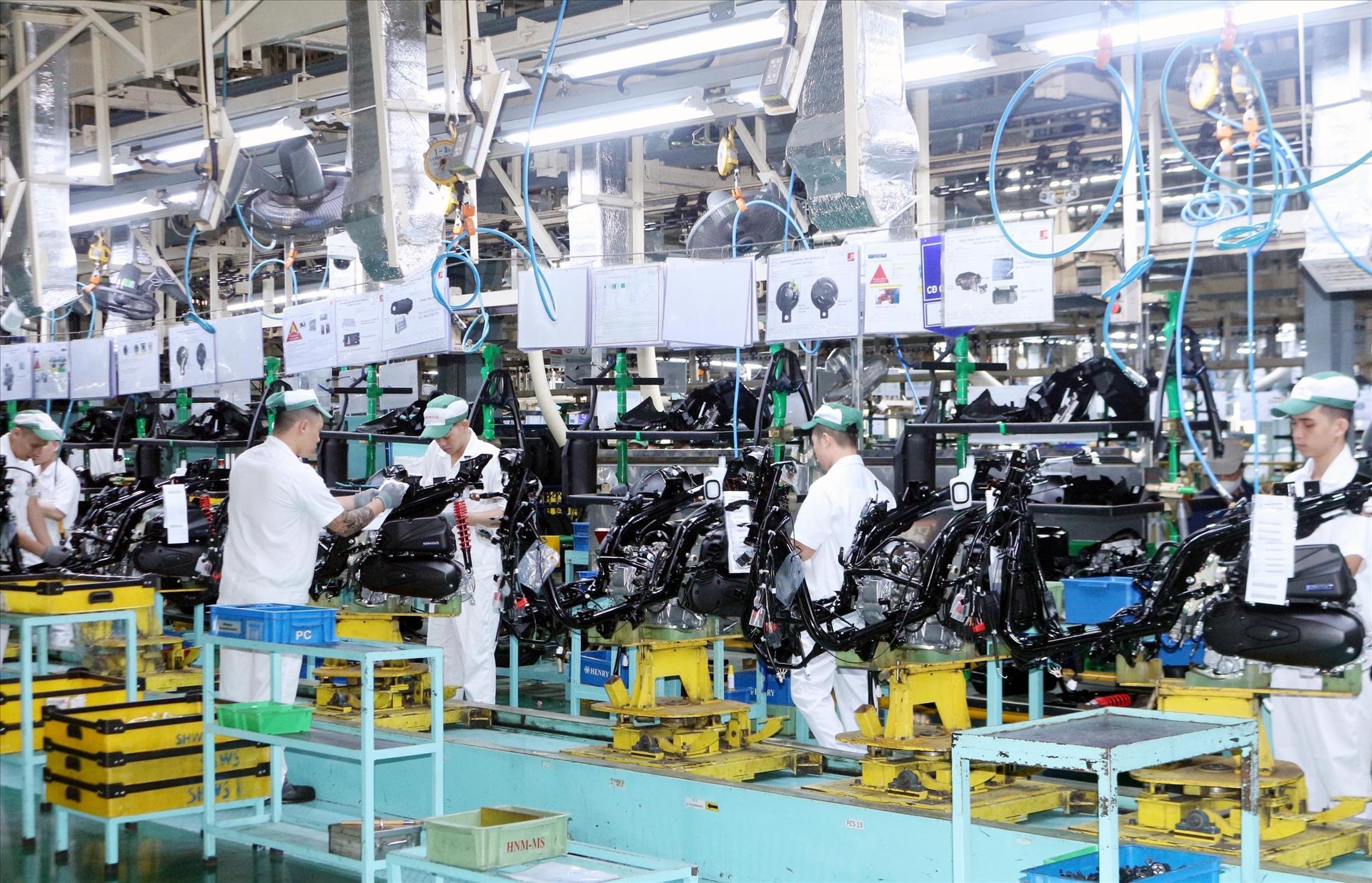
he documents of the 14th National Party Congress clearly reflect a new advance in the Party’s development thinking by identifying science and technology, innovation and digital transformation as the primary drivers of the new growth model. (In the photo: Production line at Honda Vietnam Company, Dong Van II Industrial Park) Photo: Vietnam News Agency
Fourth, the spirit of “strategic autonomy” – a new development in the Party’s theoretical thinking and nation-building vision
The 14th National Party Congress, for the first time, established the concept of “strategic autonomy” as a principled orientation guiding the formulation and implementation of the country's development policies in the new period. Party General Secretary To Lam emphasised that the overarching spirit of the new term is: “Strategic autonomy, seizing opportunities, fostering unity and concerted action, overcoming all challenges, and powerfully inspiring the aspiration for development.”(3) The formal incorporation of “strategic autonomy” into the documents of the 14th National Party Congress is not merely the addition of a new term. It reflects an important advance in the Party’s theoretical thinking on independence, self-reliance and the path towards the country’s sustainable development under new conditions.
“Strategic autonomy” reflects a significant elevation in awareness, from independence and self-reliance in specific sectors to independence and self-reliance at a comprehensive, strategic level encompassing the entire process of national development. First and foremost, it is autonomy in thinking and development orientation - a prerequisite for ensuring that Vietnam remains steadfast on its chosen path at a time when the world is undergoing unprecedentedly rapid and complex changes. At the same time, strategic autonomy in the economy is identified as the material foundation of national independence, requiring the building of a resilient, adaptable, and internationally competitive.
Autonomy in science and technology, innovation and digital transformation is becoming a key factor in enhancing the country’s capacity for independent and sustainable development.
In parallel, cultural autonomy serves as the spiritual foundation that ensures development remains on the right track, preserving national identity and the endogenous strength of the nation.
In particular, autonomy in national defence, security and foreign affairs constitutes a pillar that safeguards a peaceful and stable environment, thereby creating favourable conditions for national development.
The concept of strategic autonomy is a consistent continuation and development of the Party’s ideology of national independence, self-reliance and self-strengthening, formed on the foundation of Marxism–Leninism and Ho Chi Minh Thought, and tested through Vietnam’s revolutionary practice. In the context of deepening globalisation and intensifying strategic competition, strategic autonomy does not mean isolation or self-seclusion. Rather, it signifies proactive international integration on the basis of maintaining independence and self-reliance, while safeguarding national interests. It represents the clearest expression of the Party’s political mettle, strategic planning capacity and nation-building vision, creating a solid foundation for Vietnam to proactively shape its development path, enhance its international standing, and effectively adapt to the uncertainties of the times.
Fifth, the spirit of daring to think, daring to act, and daring to take responsibility – a key requirement for building a contingent of capable and responsible cadres and Party members
The 14th National Party Congress places particular emphasis on the requirement to build a contingent of cadres and Party members with firm political courage, innovative thinking, and a proactive and creative spirit, who are willing to take responsibility in the interests of the collective. This is not only a matter of individual qualities, but also a decisive condition for enhancing the Party’s leadership and governing effectiveness, as well as the country’s governance capacity in the new context. At the heart of this spirit is the need to awaken and fully promote a strong sense of responsibility, an aspiration to contribute, and a spirit of action in service of national development and the people’s well-being, first and foremost among cadres and leaders, particularly those holding key positions.
A significant new point set out by the 14th National Party Congress is a strong shift from a passive management mindset, characterised by formalistic compliance, to a proactive, creative and results-oriented approach grounded in responsibility for outcomes. Cadres and Party members are not only required to properly fulfil their assigned duties and responsibilities, but also to actively innovate their thinking, seek effective solutions, and demonstrate the courage to think, act and take responsibility before the Party and the people for their decisions.
At the same time, the Congress sets an urgent requirement to thoroughly address the tendency to avoid responsibility, buck-passing, and a mentality of fear of mistakes or fear of accountability. These shortcomings undermine policy implementation, hinder the development process, and weaken public trust.
The 14th National Party Congress clearly affirms that the value and vitality of resolutions do not lie in wording or slogans, but are tested through concrete results in practice, reflected in substantive socio-economic progress and the growing satisfaction of the people. This requires cadres and Party members to truly become the agents of change and the pioneering force in implementing the Party’s policies, turning guidelines into reality.
The spirit of daring to think, daring to act and daring to take responsibility is not only a matter of working methods, but also a clear expression of political courage, revolutionary ethics, and a sense of duty in serving the Fatherland and the people. This is a decisive factor in unlocking resources, improving the effectiveness of implementation, and generating new momentum for the country’s rapid and sustainable development in the new era.
Sixth, the spirit of decisive action – “saying less, doing more, acting immediately and seeing things through to completion” – a key factor in ensuring the rapid and effective implementation of Party Congress resolutions
The 14th National Party Congress places particular emphasis on the spirit of decisive action, considering it a crucial factor determining the effectiveness of the Party’s leadership and the success of the country’s development cause in the new period. Party General Secretary To Lam pointed out that one of the major shortcomings is that many correct policies and guidelines have not been effectively implemented in practice(4). In reality, a key weakness at present is that while many policies are sound, their implementation remains ineffective. This highlights that the gap between policy formulation and implementation results remains a fundamental issue that must be thoroughly addressed. It requires a strong shift from a mindset focused on orientation to one focused on action, and from an emphasis on issuing resolutions to prioritising the effectiveness of their implementation.
The spirit of action set out by the 14th National Party Congress is one of substantive, decisive and thorough implementation, guided by the principles of “saying less, doing more” and “saying and doing go hand in hand”, with concrete results serving as the measure of leadership capacity, management effectiveness and individual and organisational responsibility. Accordingly, the responsibility for implementation does not stop at the level of ideological awareness or dissemination. It must be translated into feasible programmes, plans, mechanisms, policies and solutions, ensuring coordinated and effective implementation across the entire political system. The Congress calls for the thorough elimination of formalism, the disease of chasing achievements, short-term thinking associated with office terms, as well as manifestations such as “talking much, doing little”, “talking well, doing poorly”, or a lack of determination in implementation.
At the same time, the 14th National Party Congress emphasises the responsibility of Party committees, Party organisations, agencies, units, and cadres and Party members to promptly bring the resolutions into practice through their urgent institutionalisation, concretisation, and serious, coordinated and effective implementation. The mobilisation and efficient use of all resources, the promotion of the strength of the great national unity bloc, and the close combination of political will with organisational capacity are identified as essential preconditions for realising the objectives and tasks set by the Congress.
Beyond the key features outlined above regarding the new spirit of the 14th National Party Congress documents, the documents of the Communist Party of Vietnam’s 14th National Congress also contain numerous orientations of strategic significance across the fields of politics, economy, culture, society, national defence, security and external relations. Prominent among these is the affirmation of the aspiration to build a prosperous, civilised and happy country as a core and overarching value throughout the national development orientation in the new period. This aspiration is not confined to a qualitative goal; rather, it is placed within the framework of sustainable development, linking economic growth with social progress and equity, improving living standards, and promoting the comprehensive human development.
At the same time, the 14th National Party Congress sets higher and more demanding requirements for Party building and rectification, as well as for the political system as a whole, considering this a decisive factor in the success of all policies and guidelines. These requirements include strengthening leadership and governing capacity; consolidating political steadfastness and revolutionary ethics; building a clean, strong Party that is “ethical and civilised”; enhancing the close ties between the Party and the people; and taking the people’s happiness and satisfaction as an important benchmark for evaluating the performance of Party organisations and the entire political system.
The 14th National Party Congress has opened a new stage in the country’s development amid a context in which major opportunities are interwoven with considerable challenges. In this context, bringing the new vision of the Congress documents into practical implementation is not only a regular political task, but also an imperative for development and a driving force encouraging the entire Party and people to carry out implementation in a timely, flexible and effective manner. This aims to meet the requirements of the country’s rapid and sustainable development, safeguard the highest national interests, and bring about significant changes through concrete and sustainable development achievements across all sectors of national life./.
---------------
(1) See: “Report on the documents submitted to the 14th National Party Congress”, Communist Party of Vietnam Portal, February 11, 2026, https://tulieuvankien.dangcongsan.vn/bo-chinh-tri-ban-bi-thu-ban-chap-hanh-trung-uong/dai-hoi-dang/lan-thu-xiv/bao-cao-ve-cac-van-kien-trinh-dai-hoi-xiv-dang-cong-san-viet-nam.html?categoryId=3000412
(2) Prof. Dr To Lam: “Closing speech at the 14th National Party Congress”, Communist Review, No. 1078, January 2026, pp. 74-75.
(3) See: Prof. Dr To Lam: “Closing speech at the 14th National Party Congress”, ibid., p. 74.
(4) See: “Report on the documents submitted to the 14th National Party Congress”, Communist Party of Vietnam Portal, February 11, 2026, ibid.


