

The 1975 Great Spring Victory – Lessons in promoting the spirit of determination to fight and win in national construction and defence
During the resistance war against US imperialists for national salvation, with sound strategic guidelines and revolutionary methods that embodied the people’s aspirations, the Communist Party of Vietnam inspired and united the will, determination, and strength of the nation and the times, accomplishing the historic mission of liberating the South and reunifying the country.
Inheriting and promoting the glorious tradition, the indomitable will to fight and win, and the aspiration for peace, the entire Party, people and army continue to strengthen solidarity, unity, collective efforts, and consensus, overcoming all difficulties and challenges to firmly build and defend the Fatherland in the new era of development.
The 1975 Spring General Offensive and Uprising was a monumental achievement of the Vietnamese nation in the cause of national liberation.
Under the leadership of the Party and President Ho Chi Minh, the entire Party, people, and army fulfilled President Ho Chi Minh’s sacred aspiration to liberate the South, reunify the country, and bring the people of the North and the South together under one roof.
That victory marked a decisive turning point, ushering the Vietnamese nation into a new era of independence, reunification, and socialism. It also imparted valuable lessons, including the lesson of upholding the spirit of determination to fight and win in the cause of building and defending the Socialist Republic of Vietnam.
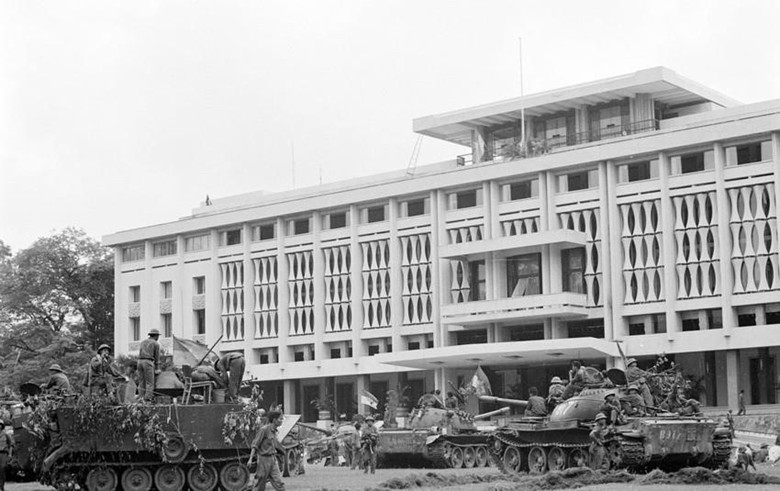
A tank of the South Vietnam Liberation Army captures the Presidential Palace of the Saigon puppet regime at noon on April 30, 1975. Photo: Vietnam News Agency
First, remain steadfast in the goals of national independence and socialism, uphold the Party’s leadership, and ensure the highest unity of will and action in the entire Party, people and army.
During the resistance war against US imperialists, the strategic guideline of upholding the banner of national independence and socialism, while simultaneously and closely combining two revolutionary strategies: the people’s national democratic revolution in the South and the socialist revolution in the North, met the aspirations of the people and became their sacred sentiment and indomitable will, aligned with the realities of the Vietnamese revolution and the general trend of the global revolutionary movement.
Such goals became the banner rallying all social forces, classes, religions, and ethnic groups across the country into a unified national strength, in combination with the strength of overseas Vietnamese communities and the solidarity and support of people and revolutionary forces around the world striving for peace, national independence, democracy, and social progress, creating a comprehensive power to resist US imperialist aggressors.
Thoroughly grasping the Party’s political and military guidelines, the people and army of the South endured all hardships, losses, and sacrifices to promote the building and consolidation of their forces, combining armed struggle with political struggle, successively defeating the war strategies of US imperialists.
Fully understanding the Party’s strategic resolve, the people and army of the North triumphed over the war of destruction, firmly defending the socialist North - the revolutionary stronghold of the nation.
Seizing opportunities, the people and army of the North and the South closely coordinated and concentrated all efforts to launch the Spring General Offensive and Uprising in 1975, liberating the South and reunifying the country.
Today, in the context of increasing globalisation and deepening international integration, the world and regional situations have rapidly evolved, become more complex, with potential risks of instability and unpredictability; opportunities and challenges, as well as partners and adversaries, are intertwined.
Meanwhile, hostile, reactionary forces and political opportunists continue to step up their activities to undermine the Vietnamese revolution through the strategy of “peaceful evolution” and a variety of highly sophisticated and insidious tactics.
In this context, it is all the more necessary to maintain unwavering steadfastness in the goals of national independence and socialism, firmly uphold Marxism-Leninism and Ho Chi Minh Thought, and place absolute trust in the Party’s leadership. It is crucial to “maintain and strengthen the Party’s absolute, direct, and comprehensive leadership, as well as the unified and centralised management of the State over the People’s Army” (1).
It is essential to continue to thoroughly grasp and seriously and effectively implement the Party’s reform policies; regard economic development as the central task, Party building as the key task, cultural development as the spiritual foundation of society, and the enhancement of national defence and security as a vital and regular mission; closely combine socio-economic development with the strengthening of national defence, security, and foreign affairs.
During the implementation process, it is essential to remain steadfast in strategic goals and principles; maintain flexibility and adaptability in tactics; ensure both cooperation and struggle; persistently and resolutely safeguard national independence, sovereignty, unity, and territorial integrity; and protect national interests as the supreme objective. At the same time, it is necessary to preserve a peaceful and stable environment to build a prosperous, democratic, equitable, and civilised country.
It is important to proactively combat and defeat all plots and sabotage activities of hostile, reactionary forces, and political opportunists.
It is also necessary to resolutely defend the Party’s guidelines, viewpoints, and ideological foundation, while upholding the Party’s leadership over the State, society, and the cause of national construction and defence.
Second, closely follow and firmly grasp the reality; accurately assess and forecast the situation; proactively handle circumstances in a timely and effective manner, avoid being passive or caught by surprise.
Grasping the situation is a crucial foundation for fostering the will and determination to fight and win.
During the resistance war against US imperialists, the Communist Party of Vietnam and President Ho Chi Minh always proactively assessed the overall and battlefield situations, formulating appropriate, sound, and creative strategic decisions.
Drawing on a solid comprehension of the laws of revolution and revolutionary warfare, as well as practical insights, the Politburo and the Central Military Commission accurately analysed and assessed the enemy’s strengths to contain and overcome them, while detecting their fatal weaknesses for full exploitation. At the same time, all efforts were concentrated on delivering decisive blows to change the course of the war, secure victory step by step, and advance toward the final triumph.
During the 1975 Spring General Offensive and Uprising, the Politburo and the Central Military Commission displayed remarkable sensitivity in seizing, creating, and accelerating the right opportunities. They continuously reinforced their strategic resolve, keeping pace with the rapid changes on the battlefield, and creating elements of surprise.
Faced with rapid developments, the basic plan for liberating the South was continuously adjusted to align with reality.
In late March 1975, the Politburo concluded: “The revolutionary war in the South has not only entered a phase of rapid development, but the opportunity to launch a general offensive and uprising in Saigon-Gia Dinh has matured. From this moment, the final strategic battle of our army and people has begun.” (2)
The lesson of proactiveness, creativity, and the ability to analyse practical situations, identify development patterns, and act accordingly, remain highly relevant in today’s revolutionary practice.
After nearly 40 years of Doi moi, the country has achieved tremendous, historically significant accomplishments.
However, the global and regional situations are changing rapidly and unpredictably, while hostile, reactionary forces and political opportunists continue to promote their “peaceful evolution” strategy, “self-evolution” and “self-transformation” from within, seek to “depoliticise” the army and “civilianise” the military.
Therefore, the strategic forecasting, research, accurate assessment of situations, and clear awareness of both partners and adversaries, are of special significance to provide timely, accurate, and effective advice; manage domestic and international relations properly, ensure national interests, and firmly defend the independence, sovereignty, unity, and territorial integrity of the Fatherland.
Applying historic lessons to the cause of building and defending the Fatherland “early, from afar, and before dangers arise,” the Vietnam People’s Army, together with all levels and sectors, must “enhance strategic forecasting capacity and maintain strategic initiative, avoid being passive or caught by surprise in any situation.” (3)
Third, harness the strength of the great national unity bloc along with the strength of the times, and awaken the Vietnamese people’s aspiration to progress.
During the resistance war against US imperialists and the 1975 Spring General Offensive and Uprising, by promoting the nation’s internal strength and combining it with the strength of the times, Vietnam achieved a great victory of epochal significance.
Based on the analysis and assessment of the domestic and international situations, as well as the positions and strengths of the country and the enemy, particularly the actual developments on the battlefield, in October 1974, the Politburo decided to mobilise the entire Party, people and army in the North and the South to launch a general offensive and uprising, completely liberating the South, reunifying the country, and accomplishing the people’s national democratic revolution.
The urgent task was defined as follows:
“From now on, we must carry out all preparations urgently, create the most optimal conditions and material facilities to strike hard, strike quickly, and win rapidly and completely.” (4)
The strength of strategic rear was fully mobilised and leveraged for maximum efficiency.
With the spirit of “all for the front” and “all for victory,” the whole country devoted all efforts to the strategic decisive battle.
The Central Committee for Support to the Southern Front, chaired by Prime Minister Pham Van Dong, was established with the task of “considering and deciding on the most active and effective policies, plans, and measures to direct and supervise Party committees and authorities at all levels to promptly mobilise human and material resources, meeting every need of the Southern front under the new situation.”(5)
With the view that the Vietnamese revolution is part of the global revolution, steadfast in implementing the guideline of pure international solidarity, seeking the support from people worldwide, Vietnam received immense assistance from democratic and progressive forces across the globe, including the progressive American people, and especially from fraternal socialist countries, contributing to the complete victory of the 1975 Spring General Offensive and Uprising.
In the context of more extensive and intensive international integration, the strength of the nation must always be closely linked with the strength of the times, international integration and defence diplomacy must be carried out actively, proactively, skillfully, flexibly, substantively, and effectively, creating a security belt to defend the Fatherland early and from afar.
All agencies and units of the armed forces must thoroughly grasp and consistently implement the Party’s foreign policy of independence, self-reliance, multilateralisation, and diversification; actively and proactively promoting comprehensive, substantive, and effective international integration; maintaining a peaceful and stable environment and continuously enhancing Vietnam’s stature and prestige on the global stage.
Strengthen bilateral diplomacy and elevate multilateral diplomacy; actively and proactively contribute to peace, friendship, cooperation, and sustainable development.
Promote Vietnam as a friend, a trusted partner, and a responsible member of the international community; leverage international resources and support to create a peaceful environment and favorable conditions for national construction and defence.
Thoroughly grasp strategic orientations and plans to defend the Fatherland early and from afar, “protect the country before it is in danger” through peaceful means.
During the implementation process, it is necessary to steadfastly follow the principle of being “active, proactive, steadfast, flexible, and effective,” in line with the philosophy of “Vietnamese bamboo diplomacy”; at the same time, remain alert and timely in detecting, preventing, and pushing back risks of confrontation, conflict, and war.
Consistently implement the principle of combining cooperation with struggle; remain steadfast and persistent in strategic principles; remain flexible and adaptable in tactics, making defence diplomacy an effective instrument and key channel of the Party and State’s foreign relations.
Develop defence cooperation with all countries, especially neighboring states, members of the Association of Southeast Asian Nations (ASEAN), major powers, strategic and comprehensive partners, and traditional friends; build trust and garner international support to prevent the outbreak of war.
On the basis of firmly upholding the “Four Nos” defence policy, create a strategic balance in relations with partners, achieve strategic objectives, and ensure the highest national interests, in accordance with the fundamental principles of the United Nations Charter and international law.
At the same time, fully leverage external resources to strengthen national defence capabilities; diversify partners to promote cooperation in developing the defence industry and military technology, in combination with equipping new cutting-edge weapons and military hardware, linked with technology transfer, particularly advanced technologies.
Proactively participate in United Nations peacekeeping operations; strengthen exchanges of military delegations at all levels; engage in high-level defence policy dialogues; attend international and regional forums, all aimed at enhancing friendship and mutual understanding, building strategic trust and preventing conflicts, contributing to raising the stature and prestige of the country and the army on the international stage.
Fourth, focus on building a lean, strong, and politically, ideologically, and organisationally robust People’s Army of Vietnam, with high overall quality and superior combat capability.
In the history of Vietnam’s national defence, no military campaign has held as much significance as the Ho Chi Minh Campaign.
Carrying out the will and determination of the entire Party, people, and army, within a short span of time, an unprecedentedly large military force was mobilised, forming an overwhelming position ready to destroy and disintegrate the enemy’s largest defensive group at its headquarters.
After more than 80 years of building, fighting, and growing, the Vietnam People’s Army has consistently embodied the nature and tradition of a revolutionary army, born from the people and fighting for the people. It is the absolutely loyal and reliable political and fighting force of the Party, the State and the people.
Under any conditions or circumstances, the Vietnam People’s Army has always remained united and closely bonded with the people, upholding the spirit of ingenuity, courage, and determination to fight and win; excellently fulfilling all tasks assigned by the Party, the State, and the people. It is truly worthy of the honourable title “Uncle Ho’s soldiers” and stands as the heroic Army of the heroic Vietnamese nation.
In response to the requirements and tasks of building and defending the country in the new context, the Party, State, and people have always paid due attention to developing the armed forces in general, and the Vietnam People’s Army in particular, to be strong in all respects, with comprehensive capabilities and high combat readiness, prepared to undertake and successfully complete any assigned mission.
The army not only excels in its role and missions as a fighting force, but also performs as a working force, labour force, and production force, actively contributing to national development and enhancing Vietnam’s image, stature, and prestige in the international arena.
In the cause of building and defending the country, special attention must be paid to developing a balanced and coordinated three-component armed force; building the Vietnam People’s Army to be revolutionary, regular, elite, progressively modernised, with comprehensive capabilities and high combat readiness.
Above all, it must be strong politically, ideologically, ethically, organisationally, and personnel-wise, ensuring that the army truly serves as a political force and a fighting force that is absolutely loyal and trustworthy to the Party, State and people, and as the core force in the mission of defending the Socialist Republic of Vietnam.
Fifth, build and promote political and spiritual factors, which are the source of the determination to fight and win.
The Great Spring Victory of 1975 was a triumph of Vietnamese courage, strength, and wisdom - the victory of the Vietnamese people’s war, in which political and spiritual strength was the fundamental, primary, and decisive factor.
Under the Party’s leadership, Party committees and organisations, political officers, and commanders at all levels implemented measures to educate and strengthen the soldiers’ ideology and morale, while also addressing their difficulties.
As a result, cadres, soldiers, and the people remained steadfast in the goal of national independence, clearly understood both advantages and challenges, and thus fostered the will to fight and win through creative and practical approaches.
Discipline and the determination to fight and win were continually reinforced, creating an overwhelming advantage in political and spiritual strength throughout the resistance, especially during the strategically significant turning point, culminating in the 1975 Spring General Offensive and Uprising, which liberated the South and reunified the country.
From the lessons of the 1975 Great Spring Victory, it is clear that efforts must continue to effectively promote political and spiritual factors in the new situation.
Special attention should be paid to strengthening leadership and direction to enhance the quality of political and ideological education, ensuring that the army always upholds its working-class nature, remains steadfast in the goals of national independence and socialism, and stays absolutely loyal to the Fatherland, the Party, the State, and the people.
First and foremost, it is necessary to lead and direct the effective implementation of Directive No. 2423-CT/QUTW, dated November 9, 2023, issued by the Standing Board of the Central Military Commission, on “renewing and improving the quality of political education in the new period,” focusing on building the political will, moral qualities, and lifestyle of cadres and soldiers, serving as the foundation for building a politically strong and elite army and enhancing its comprehensive capabilities and combat strength.
It is crucial to proactively struggle against and refute erroneous and hostile viewpoints; effectively prevent and combat manifestations of political and ideological degradation, “self-evolution” and “self-transformation.”
Efforts must be made to defeat the plots, schemes, and activities of “peaceful evolution,” “depoliticisation” of the army, and “civilianisation” of the military.
The Party’s ideological foundation must be firmly safeguard within the army, contributing to the protection and creative development of Marxism-Leninism, Ho Chi Minh Thought, and the Party’s guidelines and policies, as well as the State’s laws.
Continued efforts are essential to defeat all plots and schemes by hostile, reactionary forces, and political opportunists seeking to sow division among the Party, the State, the army, and the people.
----------------------------------------------
* Senior Lieutenant General, Secretary of the Party Central Committee, Standing Member of the Central Military Commission, Director of the General Department of Politics of the Vietnam People’s Army.
(1) Documents of the 13th National Party Congress, National Political Publishing House, Hanoi, 2021, vol. I, p. 160.
(2) Complete Collection of Party Documents, National Political Publishing House, Hanoi, 2004, vol. 36, p. 95.
(3) Documents of the 13th National Party Congress, ibid., vol. I, p. 159.
(4) Complete Collection of Party Documents, ibid., vol. 35, p. 185.
(5) Complete Collection of Party Documents, ibid., vol. 36, pp. 82-83.
(6) See: Documents of the 13th National Party Congress, ibid., vol. II, pp. 331–332.


